
24 July 2026 • 8 minute read
Select Committee proposes further weakening of environmental protection and other minor amendments to Planning Bill and Natural Environment Bill despite significant opposition
Report overview
On Monday 20 July 2026, the Environment Select Committee released its highly anticipated report into the Planning Bill and the Natural Environment Bill. Together these Bills will replace the existing Resource Management Act 1991 (RMA) and provide the environmental and planning law legislative foundations in New Zealand. At a basic level, the framework provided through the Bills will ultimately determine what development happens where in New Zealand1.
The nearly 150-page commentary will likely be a disappointing read for many who took the time to provide carefully considered and thoughtful submissions on the Bills (over 3,000 submissions were lodged). This is because, as the opening paragraph of the report states, many of the changes proposed are “technical in nature and focus on improving the bills’ workability rather than signalling significant policy changes to the bills as introduced”. Significant issues with the policy direction in the Bills (ie, reference to Henry VIII clauses and the level of discretion (and potential for interference) provided to the Minister) and the resulting consequences were acknowledged in the report. In response, the Select Committee declared it was not “necessary to change the overall approach” or to make “major policy changes” and at times proposed amendments that are likely to increase, as opposed to soothe, identified concerns.
Public response to the Report
Following the publication of the Select Committee report, there have been several press releases highly critical of the proposed replacement RMA system. The Environmental Defence Society has stated that “the recommendations will make the Bills even worse” and made the following comment “Let’s call a spade a spade: what we are seeing is a dismantling of decades of environmental progress”. In addition, the Parliamentary Commissioner for the Environment has written to all Members of Parliament expressing concerns. He has asked that Parliament allow more time for the Bills, and refer them back to Select Committee as too much of the balance between development and environmental protection has been left to Ministers2.
Summary of changes recommended
The key features and architecture of the proposed system and two Bill approach have been retained. The Planning Bill’s purpose has been reframed as “to provide for the enjoyment of land by establishing a framework for planning and regulating the use and development of land”3. In contrast, the Natural Environment Bill’s purpose remains unchanged and is “to establish a framework for the use, protection, and enhancement of the natural environment”.
Minor amendments and drafting refinements have been proposed to a range of provisions, including the purpose and goals of each Bill and the applicable Treaty clauses, the regulatory relief framework, effects exclusions and allocation and environmental limit frameworks. No changes proposed in respect of urban trees, reverse sensitivity, dark skies, green spaces or financial contributions.
In terms of the most significant changes, we break down our “top 10” of what the Select Committee has proposed:
- Limits - Amending the goal within the Natural Environment Bill to enable the use and development of natural resources so that it is no longer constrained by enabling that use and development within environmental limits. (Natural Environment Bill, clause 11). When setting limits, a cost benefit analysis must now be undertaken (Natural Environment Bill clause 49A and 50B).
- Greenhouse gas emissions - Adding a new clause to each Bill to make it clear that adverse effects of greenhouse gas emissions are out of scope of the bills, but the positive effects and benefits of activities that avoid, reduce, remove, or displace greenhouse gas emissions are within scope. The example given by the Select Committee as to the consequence of this change is that a council would not be able to limit development in greenfield areas in order to limit associated vehicle emissions. Neither would they be able to decline applications for consents or permits based on concerns about greenhouse gas emissions (Clause 15A of each Bill).
- Natural hazard risk - Changing the approach to natural hazards from one of managing the effects of natural hazards to one of safeguarding against the risks of natural hazards (Planning Bill, clause 11). Linked to this is the proposed amendment to the Climate Change Response Act4, to require Councils to prepare adaptation plans for priority areas identified in a Regional Spatial Plan (with adaptation plans to be in place within 5 or 10 years of the Regional Spatial Plan depending on significance).
- Ministerial powers - Extending the Ministerial powers to enable activities in breach of environmental limits beyond significant infrastructure as initially provided for in the Natural Environment Bill, to any activity. The constraint is that the Minister must be satisfied that the public benefits of authorising the activities outweigh both the harm or potential harm to any aspect of ecosystem health or human health that the environmental limits were intended to protect; and community needs and aspirations (Natural Environment Bill clause 79). The Minister is also now empowered to direct a local authority to take any action it considers necessary to address any issue with the local authority’s exercise or performance of its functions, power of duties, and can direct compliance with a national instrument where the local authority has not yet done so (Planning Bill clause 203A and 204).
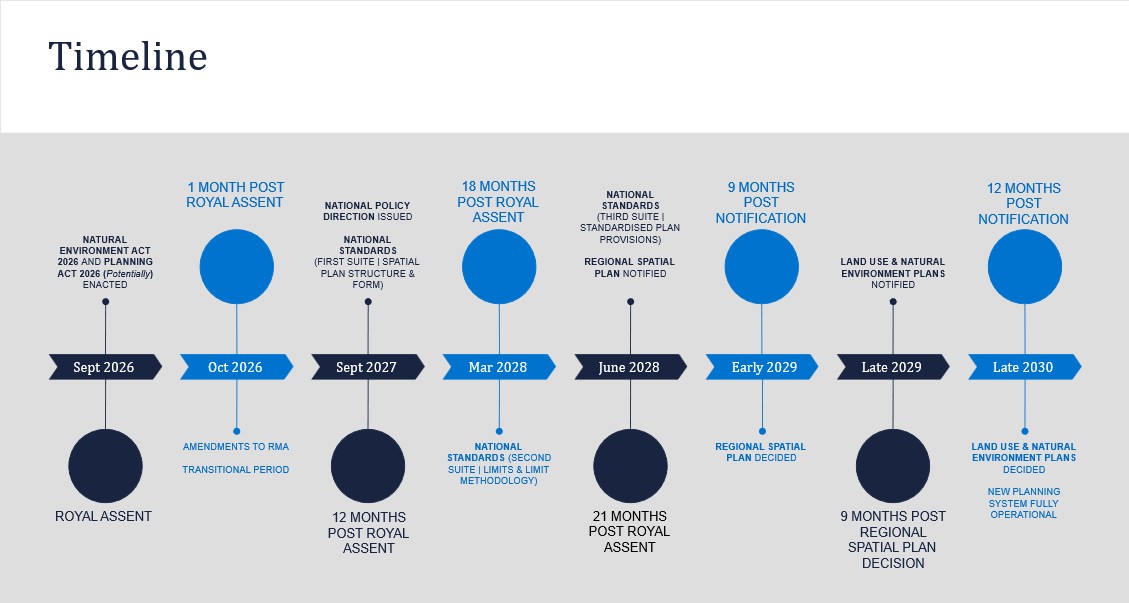
- Transition period - Lengthening the implementation timeframe and transition from the RMA to the new system. Transition will now be complete by late 2030 instead of 2029. More time has been given at the front end before national direction is required, with the same timeframes retained for the backend of the process. While getting the higher order end right in the proposed funnel system is significant, the timeframes remain tight and will put a lot of pressure on those affected and involved as the reform works its way through the system. We have provided an updated timeline showing the key planning steps in the transition below.
- Removing the precautionary principle from the system. Previously, when considering an application for a natural resource permit, the decision-maker was required to favour caution and environmental protection if the information available to determine the application is uncertain or inadequate. The Select Committee has proposed deletion of that requirement (deletion of clause 166).
- Reintroducing a controlled activity status for activities covered by Natural Environment Plans, but not Land Use Plans. The Bills as introduced proposed removing the controlled activity classification from the new consenting and permitting process. This amendment is in response to concerns expressed by submitters that drafting could result in “controlled activities” under the RMA becoming “restricted discretionary activities” in the new system, which the Select Committee considered would be contrary to the bills’ intention of being more enabling than the RMA (Natural Environment Bill clauses 32 and 33).
- Private Plan Changes - Reducing the available grounds for rejecting private plan change requests at the equivalent of the clause 25 stage to be temporal ones only. The grounds for rejection on the basis of a frivolous or vexatious request, inconsistency with the legislation, sound resource management practice or sufficiency of information are to be removed. While not expressly referenced, this appears to be in direct response to recent case law (Planning Bill, Schedule 3, clauses 51 and 52).
- Creating a new framework for Wildlife Approvals. This would run parallel to the Wildlife Act approvals process administered by the Department of Conservation and an applicant can choose which pathway they want to apply under. The Natural Environment Bill pathway would not be available on public conservation land or marine reserves (Natural Environment Bill, Schedule 2A).
- Spatial Planning - Clarifying the composition and process requirements for spatial plan committees, and processing. This includes a requirement for a spatial plan committee to be a joint committee under the Local Government Act 2002 and that one or more members need to have knowledge, skill and experience relating to te ao Māori and Māori development (Planning Bill, Clause 71 and 73A).
The Government’s response
The Government has endorsed the Select Committee report, but has taken it a step further. That is, while the Bills as introduced, and as reported back from Select Committee, provide a pathway for continued recognition of Mana Whakahono ā Rohe, the Government has announced it will be further amending the Bills to remove that pathway. This is a significant walking back by the Government of a proposal it initially put forward. It appears to be a direct response to how iwi have responded to the Bills as opposed to amendments proposed by the Select Committee.
The Bills will now need to proceed through the remaining legislative steps (Second Reading, Committee of the Whole House, Third Reading and Royal Assent) before passing into law. While the stated intention is for these Bills to be law before the election, there is not much time left for this Government to achieve that. The upcoming election means late September is effectively the deadline.
Please reach out to any of our team if you wish to discuss the Select Committee report or how the proposed legislation may impact you or your interests.
1 December article: RMA reform at a glance | DLA Piper, January article: A deep dive into RMA reform – what is changing? | DLA Piper.
2 PCE Note to Members of Parliament: Planning Bill and the Natural Environment Bill, 21 July 2026.
3 Select Committee reports back on RMA replacement bills – and it’s shocking | EDS.
4 See clause 32 of the Climate Change Response Amendment Bill.