
21 September 2026 • 15 minute read
Spring has sprung a new season of environmental regulation – the replacement RMA legislation has passed into New Zealand law
New Zealand’s Planning Bill and Natural Environment Bill have passed their third readings and are awaiting Royal assent. This article explores key late-stage changes and links to our earlier analysis of the new system.
Introduction
The Planning Bill and the Natural Environment Bill have now passed their third readings in Parliament. Together, these Bills will replace the existing Resource Management Act 1991 (RMA) and will provide the environmental and planning legislative foundations across New Zealand.
The Bills are currently awaiting Royal assent. After Royal assent, the Bills will become the Planning Act 2026 and the Natural Environment Act 2026.
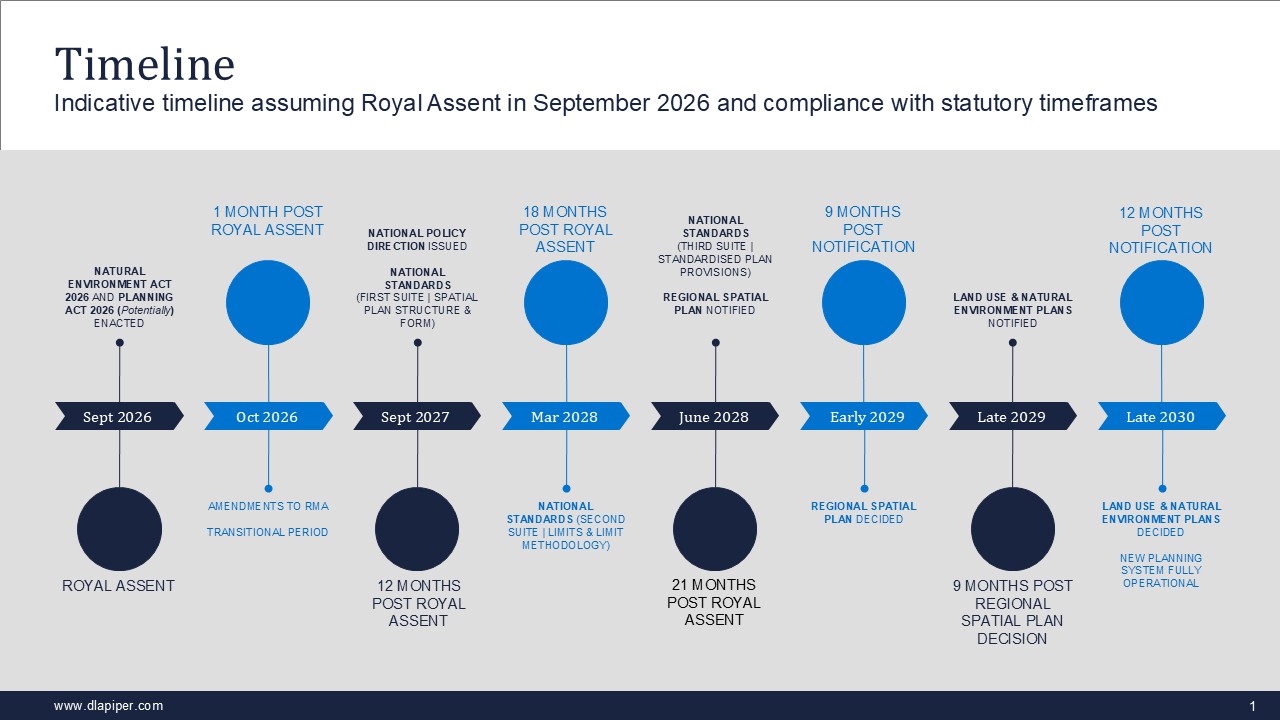
The legislation will come into force in stages. The transition period will begin one month after Royal assent and end on the day before the applicable specified transition date.
We note that Labour leader Chris Hipkins has said that if Labour wins the election this year he "would not repeal the entire system as this would take another three years…We won’t continue the repeal and replace cycle".1 This does not discount amendments.
During the transitional period, consenting for both land use consents and regional permits will continue under the RMA, with some amendments, some of which are set out below. On and from an applicable specified transition date, the new legislation may apply nationally or to specified regions or areas, and the RMA and RMA instruments will cease to apply in those regions or areas. During that same period, the new national direction and planning documents will be prepared, ready for the new regime to apply.
Changes since the Select Committee report
We have previously published a range of articles on the Bills following their introduction and the Select Committee Report:
- RMA reform at a glance | DLA Piper
- A deep dive into RMA reform – what is changing? | DLA Piper
- Select Committee proposes further weakening of environmental protection and other minor amendments to Planning Bill and Natural Environment Bill despite significant opposition | DLA Piper
This article focuses on changes made to the Bills post the Select Committee Report. These are changes made to the Bills through the Committee of the Whole House stage of the Bills, including the amendments made through the substantial Amendment Paper released by Minister Bishop on 20 August 2026 for each Bill ahead of that stage. Outlined in more detail below are the following more substantive changes.
Changes to the new system
- The indigenous biodiversity goal in the Natural Environment Bill is no longer for a no net loss outcome, but to protect significant indigenous biodiversity.
- Inclusion of express provision for how conflict between the goals in the two Bills is to be resolved and how goals are to be given effect to through the system.
- Amendments to what effects are out of scope of the new system, including changes around outstanding natural landscapes and fishing rules.
- Nelson City Council and Tasman District Council are now required to prepare a joint regional spatial plan (Planning Bill, clause 74EA).
- Introduction of a new economic referee.
Changes to the transitional regime
- The provision inserting new section 104(1A) into the RMA has been amended to reframe the effects exclusions around internal and external layouts, with a more prescriptive list of matters to be excluded now included, along with changes to sections 70 and 107 of the RMA that will apply during the transition period.
- A transitional regime for fast-track applications has been added into Schedule 11 of the Planning Bill.
- The enduring effect of Mana Whakahono ā Rohe has also been removed as previously signalled – Mana Whakahono ā Rohe will cease to have legal effect the day after Royal assent (Planning Bill, Schedule 1).
Changes to the new system
Protection of significant indigenous ecosystems, as opposed to no net loss, is now the goal
The Government’s Amendment Paper amended the goal relating to indigenous biodiversity in the Natural Environment Bill (clause 11(1)(d)) from a goal of no net loss to a goal to protect significant indigenous biodiversity. There are two dimensions to this change. The first is removing “no net loss” in exchange for “protect”. The second is the addition of a qualifier to protect only “significant" indigenous biodiversity.
Regarding the shift from “no net loss” to “protect”, after a series of questions by the Hon Rachel Brooking, the Minister responsible for RMA reform responded:
“the net loss concept was causing complications and confusions, and it’s a bit odd to have a quantification concept in a goal as well. If you look at the rest of the goals, it’s to protect, safeguard, enable, provide for, support – there are more active verbs rather than just to have no net loss. It just sat a bit uncomfortably. That was the feedback and we agreed, so we made the change”.
Regarding the addition of the “significance” qualifier, it was raised that the goal relating to indigenous biodiversity needs to be considered alongside the goal added by the select committee “to support and enable the enhancement of the natural environment”. The Minister responsible for RMA reform responded:
“the natural environment is a broad concept, indigenous biodiversity is a subset, and the goal [relating to indigenous biodiversity] is sending a message that the system should protect significant indigenous biodiversity, because that’s something special and unique to New Zealand, and something that’s worthy of protection and worthy of specific recognition and mentioning in “Goals” as worthy of protecting”.
This is not to say non-significant indigenous biodiversity is not important – it is – but it’s just a marker. And you can see this through the national policy direction framing document as well – that significant indigenous biodiversity is something that is part and parcel of the system.
The debate signals the Government has not forgotten about indigenous biodiversity that is less than significant, but that it simply forms part of the wider natural environment goal added by the Select Committee (clause 11(1)(ca)).
Changes that address how conflicts between goals in the two Bills should be resolved during the development of national policy direction
The Government’s Amendment Paper introduced amendments to the provisions in both Bills which clarify how conflicts between goals in the two Bills are to be addressed during the Minister’s development of a proposed national policy direction.
The changes adopt a similar approach to the situation where conflicts occur between goals included within each Bill. When developing a proposed national policy direction, the Minister must have regard to achieving compatibility between the two sets of goals in each Bill, as far as is practicable; and if compatibility between the two sets of goals cannot be achieved, identifying and providing for the resolution of conflict between the goals, or within a goal.
In circumstances where the Minister considers that the resolution of any conflict will result in a goal in one Bill being prioritised over a goal in the other Bill, the Minister must consider the current and long-term impacts and any severe and irreversible adverse effects as they relate to people, natural resources and the built environment. Long-term impact has been defined to mean an impact spanning two or more human generations.
While the changes do not specify any hierarchy between goals in the two Bills, they do set out matters that must be considered by the Minister when deciding how resolution of conflicts between goals should be provided for.
Further amendments have also resulted in the Bills identifying that it is the key instruments of the Bills rather than persons exercising or performing functions or powers under the Bills that must seek to achieve the goals of the Bills.
Out-of-scope effects
Clause 14 of the Planning Bill sets out the effects that are outside the scope of the new regime. It includes matters such as the layout of buildings, negative effects of trade competition, retail distribution, financial viability, views from private property, and some landscape effects (among other things). Amendments have been made to include the requirement that, for activities located more than three nautical miles from the landward boundary of the coastal marine area, effects of the activity on any outstanding natural landscape or feature, or area of high natural character, must also be disregarded.
A new clause 10B has also been inserted into each Bill in respect of rules that control fishing. Those clauses require that no instrument (ie, a regulation, national instrument, regional spatial plan, natural environment plan, land use plan, designation, natural resource permit or planning consent) made under the Planning Bill or the Natural Environment Bill can include a rule that controls fishing within the coastal marine area.
Nelson City Council and Tasman District Council are now required to prepare a joint regional spatial plan (Planning Bill, clause 74EA)
The initial versions of the Planning Bill and Natural Environment Bill allowed the local authorities of two or more regions to agree to prepare, implement and administer a joint regional spatial plan that applies to their combined regions. Minister Bishop’s Amendment Paper inserted a new clause 74EA into the Planning Bill, which requires Nelson City Council and Tasman District Council to prepare, implement and administer a joint regional spatial plan for their combined regions, in accordance with clauses 74E(2) to (3) of the Bill.
A new role will be established to ensure competitive urban land markets
A new requirement for a statutory officer to be appointed has been included through clause 188A of the Planning Bill. The statutory officer’s functions, powers and duties are set out in Schedule 10A to the Planning Bill. Among the requirements of the role, the officer is to establish, review and maintain an assessment framework for making determinations on the competitiveness of urban land markets, monitor the competitiveness of urban land markets and make determinations on the same. The officer also has an advisory function.
Clause 188B then directs how local authorities must respond to determinations that the land market is not competitive.
Changes to the transitional regime
Changes to effects excluded from consideration as part of the resource consenting process in the RMA
The Planning Bill sets out that certain effects are out of scope of the new regime. As part of the transitional provisions, the RMA will be amended in the interim so that some of those effects will be excluded from being considered under the current resource consenting process, through the period of transition from the RMA to the new regime.
Section 104 of the RMA will be amended so that, when considering a district land use activity, a consent authority must disregard adverse effects arising from any of the following as they relate to residential activities:
- The area of glazing.
- The presence or absence of balconies.
- The outdoor living space.
- The internal layout.
- The size of a residential unit.
- The size of landscaped areas (except in relation to permeability).
This replaces the previously included more general exclusion of effects relating to “the internal layout of a building or the external layout of any building on a site if the effects of the external layout remain within the boundaries of the site”.
The Government’s Amendment Paper also makes changes to the notification provisions of the RMA which mean the effects considered at both the notification and the substantive steps of a resource consent application are aligned.
Changes to discharges and ongoing plan changes
The Planning Bill makes immediate changes to sections 70 and 107 of the RMA, which currently set limits on discharges that can be permitted in regional plans or granted resource consent.
Section 70 as originally enacted prevented permitted activity rules for discharges in regional plans that produced the following effects after reasonable mixing:
- The production of conspicuous oil or grease films, or scums or foams.
- Any conspicuous change in the colour or visual clarity.
- Any emission of objectionable odour.
- The rendering of fresh water unsuitable for consumption by farm animals.
- Any significant adverse effects on aquatic life.
In 2025, the section was amended to allow permitted activity rules for discharges that produced some of the effects above (2, 4 and 5) where those effects were already occurring in the receiving waters and permitted activity standards would contribute to a reduction in those effects over time.
The Planning Bill extends this exception to all the effects outlined above. Additionally, this change will apply to a proposed plan "that is the subject of an appeal and any ongoing court proceedings”.
Section 107 as enacted prevented (subject to some limited situations) a resource consent for a discharge from being granted where the discharge resulted in the adverse effects above. In 2024, it was amended (largely in response to the High Court case of Environmental Law Initiative v Canterbury Regional Council [2024] NZHC 612) to allow resource consents for discharges that have a significant effect on aquatic life where there are already those effects in the receiving waters and conditions would result in a reduction of those effects over the life of the consent.
The Planning Bill amends section 107 to allow discharges that create all of the effects above (1–5) where the effect is already occurring in receiving waters and conditions are imposed that will reduce those effects. This change will have some retrospective effect by applying to lodged applications which have not been finally determined (ie, no notice of decision has been served or the application is the subject of an appeal).
Finally, the Planning Bill will modify Plan Change 1 to the Waikato Regional Plan with the stated aim of allowing existing intensive farming activities to continue to obtain controlled activity consents without demonstrating compliance with quantified nitrogen reduction requirements or associated nutrient modelling requirements. The Bill will also amend Plan Change 2 to Horizons’ One Plan with the stated aim that Farm Environment Plan and resource consent requirements associated with that framework do not apply before 1 January 2033.
New transitional regime for fast-track applications inserted into Fast-track Approvals Act 2024 by Schedule 11 of Planning Bill
A number of changes were made to the transitional consenting framework that will apply under the RMA. The transitional consenting provisions will apply from one month after the Planning Bill receives Royal assent until the applicable “specified transition date”. A specified transition date is likely to occur in 2030 and is the date on which the RMA will be repealed and all RMA planning instruments revoked.
Transitional provisions introduced by way of the Government’s Amendment Paper and tabled amendments include the addition into Schedule 11 of the Planning Bill of a regime setting out how fast-track applications are to be processed and decided under the Fast-track Approvals Act 2024 (FTA) during the period of transition to the new regime. Schedule 11 of the Planning Bill relates to amendments made to other legislation.
Key aspects of the transitional regime include the following:
- Referral applications that require approval under the RMA and substantive applications seeking FTA approvals lodged before the commencement of the transition period one month after Royal assent must continue to be processed and determined under the FTA and in relation to the RMA as those Acts were in force at the time the application was made.
- Referral applications that require approval under the RMA and substantive applications seeking FTA approvals lodged during the transition period but not determined by the specified transition date must continue to be processed and determined under the version of the FTA in force prior to its amendment to reflect the new regime, and the version of the RMA in force at the time the application was made.
- Where substantive applications are lodged during the transitional period and FTA approvals are granted, any land use and subdivision consents must be treated as consents granted under the Planning Act, and any regional land use consents, discharge, water and coastal permits are to be treated as if they have been granted under the Natural Environment Act.
- Where substantive applications are lodged during the transitional period and FTA approvals are granted, an application to vary any conditions (or a council-initiated review of conditions) must be carried out by the regional council or territorial authority whose functions relate to the condition(s) in question and the review must be undertaken in accordance with the Planning Act or the Natural Environment Act, as applicable.
Similar transitional provisions apply to approvals sought under the FTA for a certificate of compliance.
Mana Whakahono ā Rohe
The enduring effect of Mana Whakahono ā Rohe arrangements has been removed as previously signalled by the Minister. They will cease to have legal effect the day after Royal assent (Planning Bill, Schedule 1, clause 21).
The Government has instead introduced new clauses 198A–198E of the Planning Bill which provide an option of entering into new, narrowly scoped, “iwi participation agreements” to record how iwi authorities will participate in statutory planning processes under the Bills and processes required to give effect to Treaty settlement redress.
Conclusion
This is a time of significant change for all resource users and environmental decision-makers in New Zealand. Please contact one of the team if you would like to discuss any of these developments and their potential implications.
1 The Post media coverage, 20 July 2026