15 June 2026 • 6 minute read
Council amalgamation reform in New Zealand
On 5 May 2026, the New Zealand Government announced a revised pathway for local government reform, centred on a voluntary “Head Start” process for councils willing to move quickly on reorganisation. This reform incentivises regionally led consolidation, while retaining a central “backstop” process where councils do not opt into the Head Start process.
Overview
In late 2025, the New Zealand Government proposed changes to simplify the local government system. A key feature of the proposals was a structural shift at the regional governance level, including replacing elected regional councillors with a governance model comprised of the mayors of constituent territorial authorities. Those mayors would be responsible for jointly developing and implementing regional strategies to improve the effectiveness, efficiency, and coordination of service delivery across the region.
This reflected a broader policy objective of strengthening regional collaboration while reducing perceived duplication between territorial and regional functions.
This proposal received more than 1,150 submissions, with approximately 70 from councils and 60 from iwi/Māori organisations. There was more support for regional reorganisation plans than for combined territories boards.
However, a number of submitters raised concerns about the capacity of councils to undertake significant structural reform concurrently with other major reform programmes, including resource management reform and water services restructuring. There was also broad support for retaining existing regional councillors until at least the 2028 local elections, as a transitional measure to preserve institutional knowledge, maintain democratic legitimacy, and support mayors in any interim governance arrangements.
What is specifically proposed?
The reform programme will proceed in two stages:
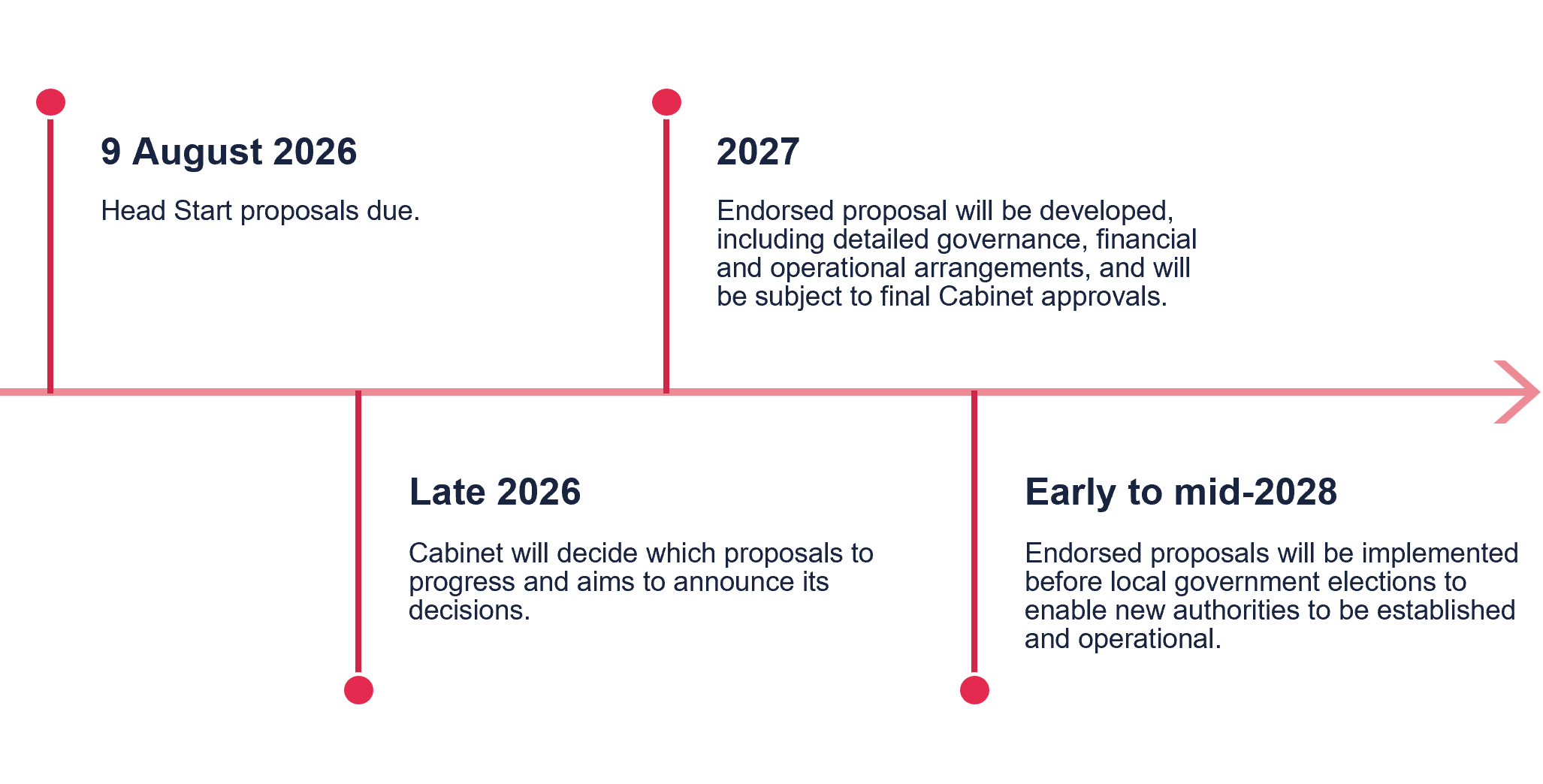
- The first stage comprises the voluntary ‘Head Start’ pathway for councils that are prepared to progress reorganisation in the near term. Under this pathway, proposals for new or expanded unitary authorities must be submitted by August 2026. Cabinet is expected to make initial policy decisions on shortlisted proposals by late 2026, with further details developed in early 2027.
- The second stage involves a broader, government-led reform process following the 2028 local government elections. This stage includes a ‘backstop’ mechanism, under which central government may intervene to implement structural changes in regions where voluntary proposals have not been advanced or do not meet the required threshold.
What is the ‘Head Start’ process?
Cabinet has established a time-limited and voluntary pathway under which councils have a three month window to develop and submit proposals for reorganisation. The proposals must outline how participating councils intend to collaborate and restructure local government arrangements within their region.
The policy focus is on the consolidation of regional and territorial functions into a single entity. The establishment of larger, more integrated unitary authorities aims to streamline governance structures and improve decision-making efficiency.
The reform programme is intended to address longstanding concerns about fragmentation within New Zealand’s local government system. These concerns include:
- Overlapping responsibilities – territorial and regional authorities share many responsibilities, including spatial planning, district plans, regional plans, policy statements and statutory environmental regulation under the Resource Management Act 1991; and the Building Act 2004. The council amalgamation proposal is intended to reduce the need for two separate authorities to handle similar tasks.
- Inconsistent regulatory approaches – local authorities vary widely in how they monitor environmental effects, enforce compliance, and set consent conditions. The Government has stated that inconsistent environmental regulation may undermine Aotearoa New Zealand's national environmental goals and make those goals harder to achieve.
- Inefficiencies in infrastructure planning and service delivery – examples include water infrastructure planning, such as under-investment in smaller councils and variation in asset quality between territorial authorities within a region; roading investment, including variation in transport planning and roading infrastructure between districts; and consenting processes, where many infrastructure projects require both regional authority and territorial authority consents, creating duplication in consultation processes, conditions, assessments and requirements between councils.
The reform programme is also designed to align local government structures with the forthcoming national planning framework, which is expected to significantly reshape spatial planning, environmental regulation, and infrastructure coordination.
For local authorities, developers, infrastructure providers and regulated industries, the announcement signals that structural change within local government may now occur on an accelerated timeline. This has potential implications for consenting pathways, plan development processes, and regulatory consistency across regions, while also offering the prospect of earlier certainty regarding institutional arrangements.
The ‘backstop’ process
The ‘backstop’ process will apply if a council chooses not to take part in the Head Start pathway. The Government will step in to ensure reform occurs through a ‘backstop process’ by setting a standard approach to reorganising local government. This process will aim to achieve similar goals to the Head Start pathway.
The aim of the backstop process is to ensure the benefits of a simpler local government system extend to the whole of Aotearoa, whether or not local authorities choose to lead the reform themselves.
The backstop process is expected to include transitional governance arrangements, such as interim boards comprising mayors or appointed representatives, to oversee the implementation of new structures. Detailed design of this process is expected to be finalised in 2027, with structural changes taking effect in time for the 2028 local government elections.
Implications for local authorities
While proposals do not need to encompass an entire region, they must demonstrate clear evidence of political support, strong governance leadership, and tangible benefits for affected communities.
The Government has signalled a clear preference for proposals that result in the creation of unitary authorities. These entities combine regional and territorial functions and, in the Government’s view, eliminate duplication, simplify governance arrangements and enable more integrated planning and service delivery at a regional or sub-regional scale.
Eligibility
To be eligible, a proposal must be jointly submitted by at least two territorial authorities. The participating authorities must collectively represent either a majority of the territorial authorities directly affected or a majority of the population within the proposed area.
The Government’s focus on territorial authority leadership means regional councils are excluded from initiating proposals. Existing unitary authorities, with the exception of Auckland Council, may opt to participate in proposals.
Proposals can cover all or parts of a region, include neighbouring councils from different regions and result in one or more unitary authorities.
Assessment criteria
Proposals will be assessed on:
- Deliverability: Proposals must be realistic, sufficiently developed, and capable of implementation within the proposed timeframe, including transition arrangements to enable establishment before the 2028 local elections.
- New planning system: Proposals must support local authorities to implement the new planning system and work with the rollout of new plans and rules. This will also aim to avoid disrupting council’s delivery of important spatial planning, environmental planning and infrastructure projects.
- Simplicity: Structural changes should reduce duplication of functions, clarify governance responsibilities, and enable more efficient decision-making processes.
- Economy: Proposals should demonstrate the potential to improve the delivery of infrastructure and public services in a cost-effective manner over the medium to long term.
- Community engagement: Proposed structures must maintain meaningful local representation, ensure accessibility to decision-makers, and appropriately reflect the diversity of communities, including by balancing urban and rural interests and recognising Māori interests and partnerships.
Upcoming next steps