27 October 2025
Government Shutdown Update: Monday, October 27, 2025
The Senate returned this evening but did not hold a vote on the continuing resolution (CR). The House remains out of session, with Speaker of the House Mike Johnson (R-LA) now indicating he will make decisions about returning on a day-by-day basis. The House has not been in session since September 19.
The American Federation of Government Employees (AFGE), the largest union of federal workers in the country, has called for Congress to end the shutdown immediately by passing a clean CR. The AFGE’s president, Everett Kelley, criticized both parties for trying to put a partisan spin on the situation and called the fact that Americans are being forced to work without pay a “national disgrace.” Federal workers represent an important contingent within the Democrats’ base, and this messaging places pressure on Democrats who could lose support from federal workers at risk of missing another paycheck.
Senators Chris Van Hollen (D-MD) and Ron Johnson (R-WI) are working to merge their two shutdown funding bills to create bipartisan legislation that would pay an unknown number of federal employees. Senate Majority Leader John Thune (R-SD) has said he is open to a compromise.
Looking Ahead
November 1
November 1 has been a day to watch from the beginning of the shutdown, as it marks the beginning of Affordable Care Act (ACA) open enrollment. Americans are expected to see the increase in their healthcare premiums firsthand. Democrats have centered all shutdown negotiations around the ACA subsidy expirations and are likely to double down on this messaging as Americans across the country are hit with higher healthcare costs. In addition to the subsidies expiring, ACA premiums are expected to spike an average of 30 percent next year.
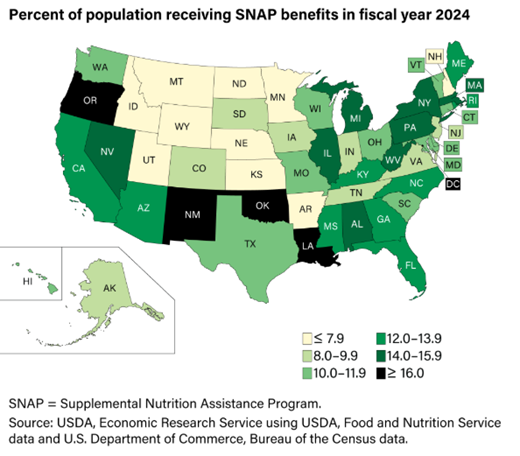
Crucial government programs are also set to lose funding on November 1. As we have discussed before, the Supplemental Nutrition Assistance Program (SNAP), which more than 40 million Americans rely on for food assistance, is set to run out of funding at the end of this week. The Trump Administration has indicated that it will not be looking to tap into emergency funds to assist the program, and Speaker Johnson has supported this move. Other Republicans, including Senate Appropriations Committee Chair Susan Collins (R-ME), have pushed for the passage of a standalone SNAP funding bill. Senator Josh Hawley (R-MO) has introduced the Keep SNAP Funded Act (S. 3024), which would fulfill this objective.
The U.S. Department of Agriculture graph below shows the nationwide distribution of Americans who receive SNAP benefits and which states will be most negatively affected.
The Trump Administration provided the Special Supplemental Nutrition Program for Women, Infants, and Children (WIC) with $300 million earlier this month, but the organization is set to run out of funding again. The program will need another bout of emergency funding to remain functional through November.
Head Start, a Department of Health and Human Services program that supports education, health, and nutrition services for children under six years old, is also set to lose federal funding on November 1. This loss of funding will result in teachers losing pay and some centers being forced to close.
Earlier this month, the Department of Transportation secured $42 million to ensure that the Essential Air Service remained operational. The Service is a government program that ensures that small, rural communities maintain minimal scheduled air service, is set to run out of funding at the end of the month. If this program shuts down, it threatens to isolate rural communities by limiting travel, medical treatments, and commercial goods.
November 4
On the first Tuesday of November, states across the country will hold various elections. Most notably, New Jersey and Virginia will elect new governors, and both the outcomes and the margins of these elections could provide insight into what the midterms could look like next fall. Additionally, New York is holding its mayoral election, and California voters are casting ballots on a new congressional district map.
These elections may give members of Congress a look at how the American people are feeling about the two main political parties and could potentially influence messaging and negotiations related to the shutdown.
November 4 marks the 35th day of the shutdown, tying it with the 2018-2019 shutdown for the longest in U.S. history.
November 15
Treasury Secretary Scott Bessent has said that military service members will start missing paychecks on November 15 if the government does not reopen. While funds have been shifted and donations made to avert missing military paychecks so far, those funds are not sustainable long term. In addition, air traffic controllers and TSA agents could miss another paycheck on November 14. The shutdown has already disrupted flights, and the Federal Aviation Administration (FAA) is warning that staffing problems are increasing at airports across the country. Last Thursday, 6,158 flight delays occurred across the nation, and the issue is expected to worsen as the shutdown continues.
As all of these issues compound, the likelihood that members will start to hear more from constituents, who are personally feeling the impact, will increase.
Thanksgiving
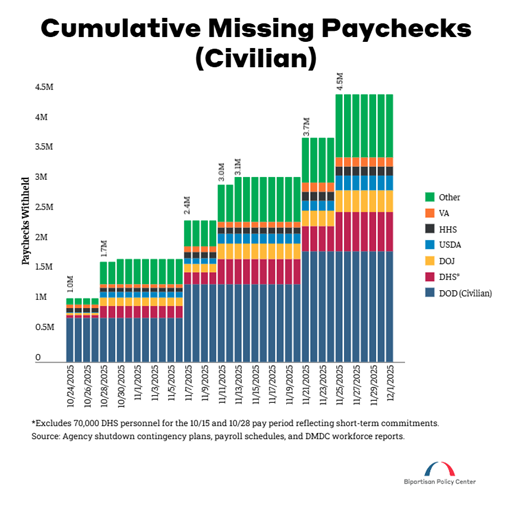
Neither the House nor the Senate is typically in session during the week of Thanksgiving so that members can be home with their families during that time. If the shutdown continues at that point, the effect on holiday travel could be profound. Below is a predictive chart created by the Bipartisan Policy Center, showcasing the number of paychecks that would be withheld from federal employees (excluding active military) if the shutdown continues.
Past updates can be found on the DLA Piper website here.
If you have any questions or would like to coordinate an individual conversation about the shutdown’s effects or about the Government Affairs & Public Policy practice, please contact practice chair Karina Lynch at karina.lynch@us.dlapiper.com.