3 October 2025
Government Shutdown Update: Friday, October 3, 2025
What is happening in Congress?
The government shutdown continues with no clear resolution in sight. This afternoon, October 3, the Senate held another vote on continuing resolutions (CR) before heading into the weekend. The Senate failed to meet the 60-vote threshold to pass the two CRs once again:
The Democrat-proposed CR (S.2882) failed by a vote of 46-52, with Senators Chris Coons (D-DE) and Jerry Moran (R-KS) not voting.
The Republican-backed CR (H.R. 5371) failed by a vote of 54-44. Senators Catherine Cortez Masto (D-NV) and John Fetterman (D-PA) remain the only Democrats to vote for the CR, while Senators Rand Paul (R-KY) and Angus King (I-ME) continue to vote against it.
Senate Majority Leader John Thune (R-SD) is optimistic, however, about the fact that two Democrats and Senator King, who caucuses with Democrats, are continuing to vote in favor of the CR. Senator Thune expresses optimism that there will be opportunities to recruit the five more Democratic votes needed to pass the CR.
Speaker of the House Mike Johnson (R-LA) has designated October 7-13 a district work period, meaning House members are expected to be back home in their districts rather than in D.C. House Minority Leader Hakeem Jeffries (D-NY) had previously indicated that House Democrats would return next week, but this new announcement makes that unlikely. It’s notable that, until the House returns, the GOP CR remains the only viable option out of this shutdown.
Much of the news has centered around Senator Jeanne Shaheen (D-NH) as a potential key Democrat in ending the shutdown. Senator Shaheen is set to retire next year, which puts her in a prime position to stray from her party. She previously voted to avoid a shutdown in March 2025 and frequently engages in across-the-aisle conversations. While she was an original proponent of the Affordable Care Act (ACA) tax credits, reports suggest she understands that a path forward may not include such concessions. Senator Shaheen is one to watch in the future, although today she voted “no” on the House-CR.
What is the Administration doing?
According to the shutdown contingency plan for the Executive Office of the President, the White House is furloughing roughly a third of its staff but will retain 45 staffers from the Department of Government Efficiency (DOGE). Additionally, 514 fewer White House staffers are being furloughed than was contemplated for the 2018 shutdown during President Trump’s first Administration.
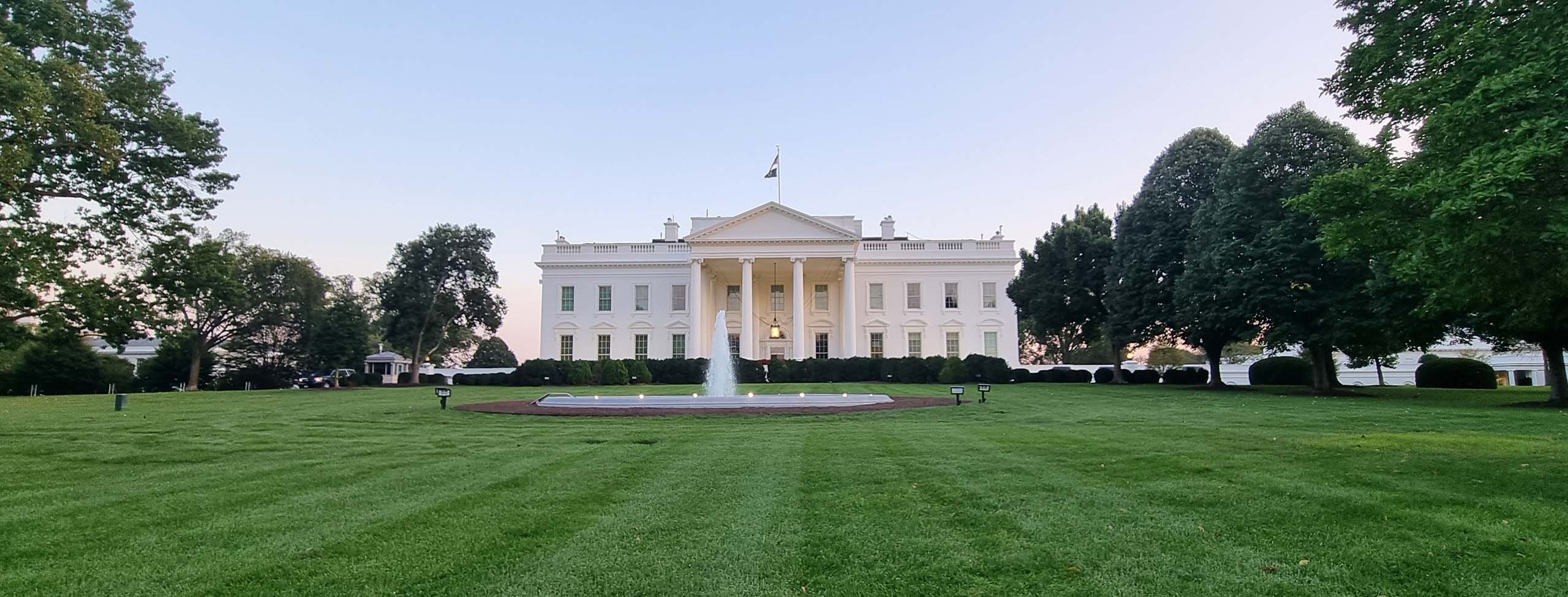
Yesterday, the Trump Administration released a memo citing quotes from news outlets across the country to demonstrate how the “Democrat shutdown hurts families, veterans, and workers.” The memo stated that “Democrats’ reckless push to hold the government hostage over free healthcare for illegal aliens has forced a crippling shutdown — making essential workers and servicemembers go unpaid, pushing vital programs like WIC to the brink, and leaving key services unfunded.” The White House website now includes a banner at the top with the words “Democrats Have Shut Down the Government” and a countdown.
Further directing its response to the shutdown at Democratic-led cities, this morning, the White House put $2.1 billion on hold for Chicago infrastructure projects, specifically the Red Line Extension and the Red and Purple Modernization Project. Office of Management and Budget (OMB) Director Russell Vought said the projects have been put on hold specifically to “ensure funding is not flowing via race-based contracting.” White House Press Secretary Karoline Leavitt said the OMB should target “agencies that don’t align with the administration’s values,” and blamed Democrats for bureaucratic layoffs as they “forced the White House and the President into this position by voting to shut the government down.”
In response to President Trump's declaration that the U.S. is at war with drug cartels, Senator Thune has cautioned that Congress would need to be consulted in the event of any long-term “sustained” U.S. military action targeting drug cartels.
What are the topline issues for the GOP right now?
While some Republicans hold the view that they have already done their work and will take a backseat during this funding lapse, the GOP may face several growing headaches throughout the shutdown’s prolongation.
There are rising concerns regarding U.S. Department of Agriculture (USDA) furloughs, as the Department has halted farm loans and payments. This has the potential to put Republican senators in a difficult situation as their constituents begin to face more troubles. Last week before the shutdown, President Trump vowed to send farmers a $10 to $14 billion cash bailout using tariff revenue in light of the industry’s current economic turmoil. However, such a bailout would require Congressional approval, so there will be no immediate relief during the shutdown. Regardless, the timing of President Trump's promised bailout could take some pressure off GOP senators who may have otherwise faced discontentment from their constituents.
The payment of nearly 2 million active-duty military service members remains a top-of-mind issue for the Republican Party. It is also an issue that appeals to the Democrats as each state’s National Guard and other military members are directly affected. There have been bipartisan discussions on using the Department of War’s reconciliation money to pay the military, and Representative Jen Kiggans’ (R-VA) bill, the Pay Our Troops Act of 2026 (H.R. 5401), remains in play with 91 co-sponsors, including members from both parties.
Addressing these issues apart from CR negotiations would relieve certain pressure points for the parties, potentially lengthening the shutdown.
Senate Majority Leader Thune is continuing to balance his leadership of the Republicans' firm stance on their CR, while also maintaining conversations across the aisle and distancing himself from Russell Vought. Earlier today, Thune said, “everybody knows Russ Vought. And so, I think you’re playing with fire when you do this,” in reference to Democrats continuing to vote against a CR, keeping the government in a shutdown. Today, standing alongside Speaker Mike Johnson at a press conference, Thune said, “There is nothing to negotiate.” In reference to ACA negotiations, Thune said he cannot guarantee a deal will materialize, but said, “If…the president’s involved and he’s driving it, maybe there’s a path forward there.” He noted that this is unlikely to happen until the government is back open.
Senator Mike Rounds (R-SD), a key player in informal bipartisan talks, stated that “I’m not optimistic that more than just a few of them [Democrats] want to get to yes” on a CR.
If you have any questions or would like to coordinate an individual conversation about the shutdown’s effects or about the Government Affairs & Public Policy practice, please contact practice chair Karina Lynch at karina.lynch@us.dlapiper.com.