23 January 2026
Navigating the new complexity: Restructuring trends for 2026
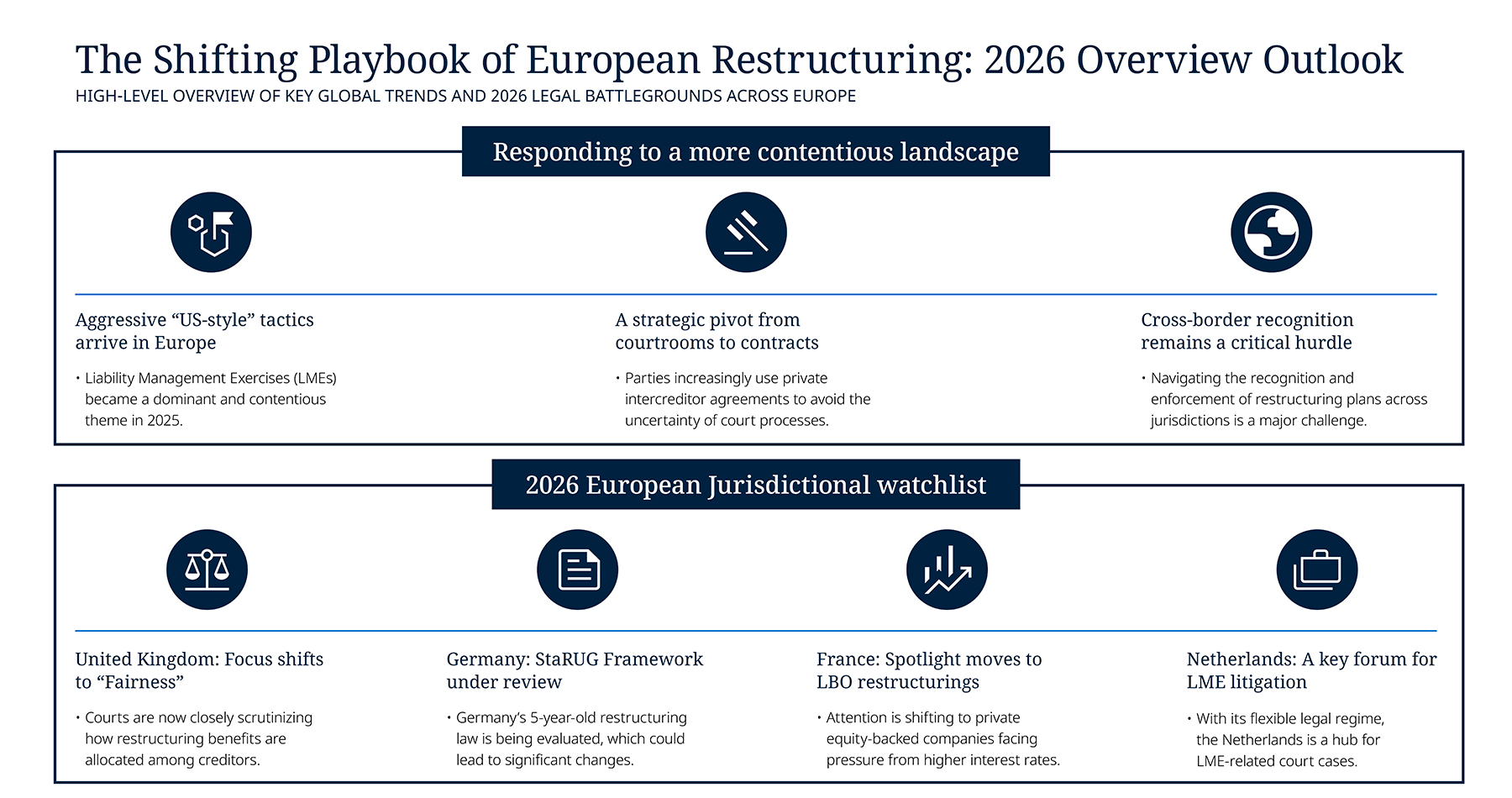
The UK restructuring landscape enters 2026 following a transformative period where the latest court-based tools were “stress-tested”. This year promises a move away from traditional consensus-building toward a more strategically complex and contentious environment. As the market adapts to recent judicial rulings and aggressive new tactics, several key trends will define the year ahead.
Restructuring Plans
The focus for the UK Restructuring Plan (RP) has shifted from jurisdictional eligibility to the court's exercise of discretion. For 2026 there is likely to be key focus on:
- Treatment of out of the money creditors and the restructuring benefit allocation: given that the refusal by the English courts of approval for the proposed Waldorf Production cross-class cram down restructuring plan is now not going to be appealed to the Supreme Court, case law may evolve more gradually.
- Creditor disenfranchisement, out of the monies and class composition: scrutiny of the exclusion of certain creditors from voting, particularly where disputed or “out-of-the-money” entitlements are being considered.
- New Restructuring Plan practice direction is intended, through the introduction of active case management tools, to manage complex challenges within a predictable timetable, fundamentally changing how proceedings are prepared and conducted. The new practice direction for schemes and plans will undoubtedly change the preparation and conducting of these proceedings - possibly resulting in both more front-loaded strategic preparation and more streamlined processes.
- Minority protections challenges: In the context of contested liability management exercises (LMEs), where there may be some desire to implement non-pro rata or coercive transactions,the UK courts will increasingly be asked to rule on their fairness. Cases similar to the situation in Assenagon, where minority creditors were afforded protections by the courts, may increasingly come into play.
For multi-jurisdictional groups, navigating the complexities of recognition and enforcement remains a critical challenge. RPs have faced some challenges in this regard as well as the rise of restructuring tools such as StaRUG in Germany, WHOA in Netherlands and Examinership in Ireland. This is changing the implementation pathway of restructurings where the choice of process (court-led versus contractual) becomes a risk and opportunity of equal importance to the commercial terms.
The rise of security enforcements and intercreditor-implemented restructurings
A significant pivot is occurring toward contract-based enforcement mechanisms as a reaction to the perceived uncertainty of court-supervised processes. We have seen a continued flow of “under the radar” security enforcements by way of appropriation in mid-market sponsor backed situations in particular, where taking the keys is the optimal way to preserve value. There is an expected acceleration in intercreditor-implemented restructurings in mid-market and larger transactions, where parties utilise “distressed disposal” provisions within LMA-style intercreditor agreements – so market participants will need to pay attention to the letter of safe harbour provisions as well as any additional risk mitigation steps beyond the contract - and the use of pre-packaged administrations. This shift prioritises the relative certainty of contractual remedies over the litigation risks inherent in the RP.
Liability Management and Minority Protections
Aggressive US-style LMEs have firmly arrived in Europe, leading to challenges based on local law principles such as “good faith“. In 2026, the UK courts are expected to provide clarity on the fairness of non-pro rata and coercive transactions, testing the strength of minority protections. Additionally, a new phase of conflict involves direct challenges to creditor cooperation agreements, which are being targeted by both debtors and excluded creditors.
Sectors to watch
Picking out 4 segments for particular attention in no particular order: technology, media and telecommunications (TMT), retail, chemicals, and renewables. Each sector has its own peculiarities but:
- TMT faces huge challenges in the tech/AI race (ie the race to commercial solutions, competition etc).
- Retail in the UK has suffered from changes to national insurance but cost inflation and demand volatility are a constant across the UK and EU.
- Chemicals In the UK and the EU, manufacturers are facing rising carbon and energy costs, while competitors in the US and China face much more benign conditions such that production is moving away from the UK and EU. The industry is lobbying to remove or reduce green levies, ensure equal access to domestic gas, reform carbon cost burdens but on the other hand there is huge pressure to maintain environmental standards. Smaller, less diversified issuers face weaker balance sheets and limited flexibility in a capital-intensive industry.
- Renewables – possibly counter-intuitive at first glance but the drive to renewables is creating not only huge opportunities but is also giving rise to not inconsiderable teething pains – particularly where policy, government subsidy, planning and grid investment and reform need to keep pace. We have seen several distressed projects across biomass, solar and wind taking in the UK, Northern and Southern Europe.