
23 March 2026 • 7 minute read
ATO response to Pepsi: What it means for cross-border IP arrangements
On 18 March 2026, the Australian Tax Office (ATO) released its Decision Impact Statement (DIS) regarding the High Court of Australia decision in Commissioner of Taxation v PepsiCo Inc [2025] HCA 30. The DIS provides taxpayers with an indication of what is to come next for those with cross-border arrangements involving the use of foreign-owned IP in Australia. Although not strictly binding on the Commissioner, it may provide some protection from penalties and interest for taxpayers that rely on it in certain circumstances.1
To recap, Pepsi enjoyed a narrow victory in the litigation, with the High Court accepting both that its arrangements (refer diagram below) did not result in royalty withholding tax (RWT) and that the diverted profits tax (DPT) did not apply. The DIS has some incisive comments which provides insights as to the arrangements the ATO remains concerned by.
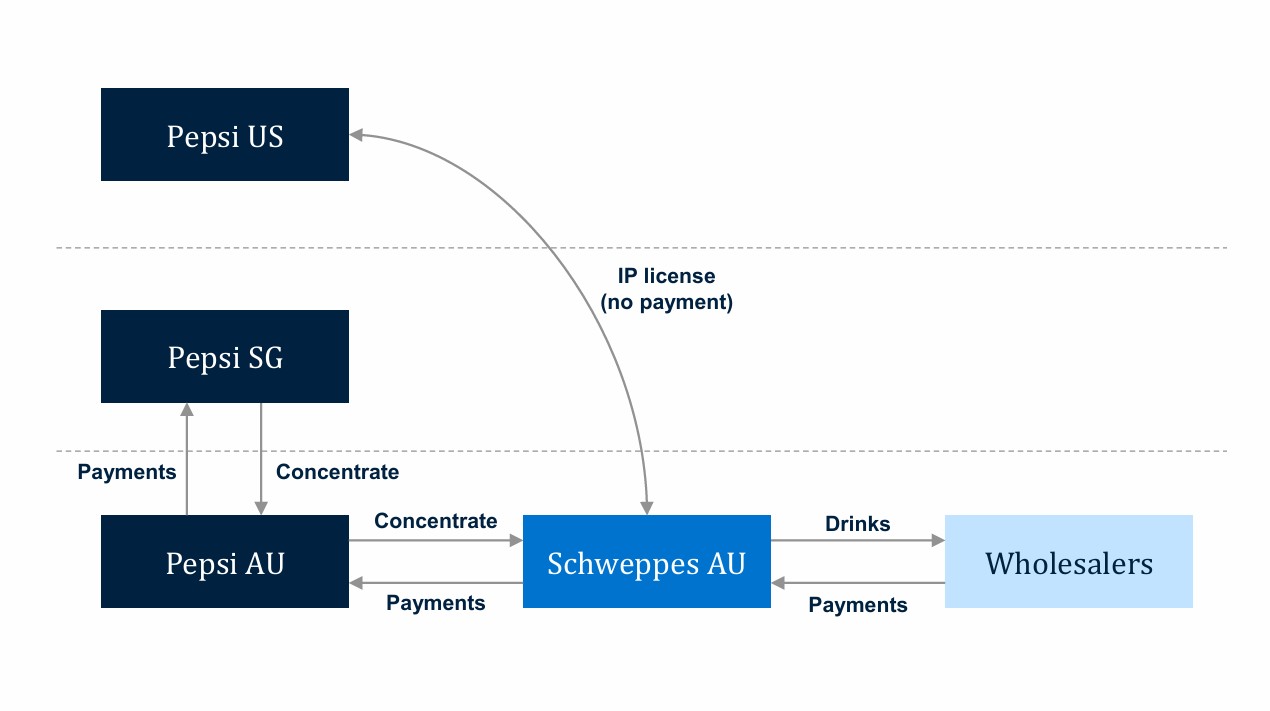
As expected, the DIS does largely confine the decision to facts and dispute issues in Pepsi. It is relatively expansive for a DIS, at 80 paragraphs, providing a detailed summary of the Court's decision and most importantly setting out the ATO's views on the implications of the decision.
Below are our key observations.
Royalty Withholding Tax (RWT) issue
- Whether RWT applies will depend on the characterisation of what a payment is made for. The ATO says it will continue to take a broad interpretation on this issue, including by reference to multiple contracts involved in an arrangement.
- The ATO maintains its position on embedded royalties. The DIS states that "[t]he characterisation of a payment is not determined by the label attached to it" and that the Pepsi decision does not mean the characterisation of a payment is not open to challenge. Perhaps more interestingly, where embedded royalties are an issue in future cases, the ATO says it will "seek to understand, and, if necessary, test, the economic fundamentals of arrangements that involve the provision of IP but where no royalty is recognised." This analysis will extend beyond the value of the IP rights to the values of other things being exchanged as part of the arrangement (e.g. goods or services).
- Any taxpayers considering revising their arrangements to recognise no royalty, but with a non-resident IP owner still being compensated for making the IP available, will be viewed as high risk by the ATO from a GAAR and/or DPT perspective.
Diverted Profit Tax (DPT) issue
- Critically, the High Court majority concluded on the evidence that the commercially standard contracting model in the beverage industry involved payments based on volume, without a separately identified royalty. In contrast, the minority viewed the same evidence as showing that there was flexibility in this model. The divergence in opinion on this topic is likely to signal where the ATO is likely to take this with other taxpayers under audit.
- The ATO references the majority's quote that Pepsi turned on "critical facts, unique to these appeals". These facts resulted in the High Court determining that no tax benefit arose for Pepsi, there being no reasonable alternative to the (highly unique) scheme in question.2
- The three critical facts, as explained by the majority at [219]-[220], were:
- "the substance of the Scheme (as properly construed and characterised) included that the price paid for concentrate was for concentrate and nothing else" (Pricing);
- "the [s]cheme was a product of arm's length dealings between unrelated parties" (Independence); and
- "the absence of a royalty was market standard, a substantive element of the business model which was adopted by the PepsiCo Group" (Market Evidence).
- It is clear that going forward the ATO expects the majority's analysis regarding tax benefit in Pepsi's case to have very limited implications for the application of the DPT or GAAR in other cases. For example, the Independence fact will not be present in intra-group IP licenses. We expect will result in the ATO placing even more scrutiny on the Pricing and Market Evidence given that the arrangements have been entered by related parties.
- The ATO notes that the High Court's decision does not address situations where the substance of the scheme includes a royalty (unlike the Market Evidence in Pepsi) but the scheme avoids RWT. It seems likely that the ATO is considering a greater role for the transfer pricing provisions based on the conditions which might operate if the related parties under review or audit were independent.
- The ATO considers that "the decision does not mean that paragraph 177CB(4)(a) requires postulates to reproduce entirely or replicate the 'substance' or 'consequences' of the scheme to be reasonable alternatives". This seems to read down the High Court's views on the misalignment between the economic substance of the scheme and the ATO's postulates, and signals that the ATO is, unsurprisingly, likely to seek to retain flexibility in the identification of reasonable alternative postulates giving rise to a tax benefit going forward. There will be an ongoing debate about the level of generality with which the scheme's substance and consequences are identified, with a closer analysis tending to identify more differences.
- The DIS emphasises that to discharge the Part IVA burden of proof, the onus is on the taxpayer to show that there is no reasonable alternative to the scheme, not only that the ATO's postulates are unreasonable.
- The ATO considers that the majority's decision opens the door to an interpretation that there can be more than one alternative reasonable postulate for the purpose of section 177CB. However, as highlighted in the DIS, this position is in contrast with a recent Full Federal Court decision which was adverse to the ATO (Commissioner of Taxation v Hicks [2025] FCAFC 171) currently the subject of a special leave application to the High Court. Expect further updates in relation to this issue, if the High Court grants the ATO leave to appeal.
What next?
The DIS makes very clear the ATO's intention to continue undertaking deep information gathering processes on these issues, including focussing on contractual arrangements, dealings between relevant parties (related or not), and communications which informed the relevant transactions. It has also flagged that pricing evidence, particularly the value of IP rights, will be key to any characterisation analysis.
Finally, the ATO continues to review its general guidance on the GAAR in PS LA 2005/24 and the draft software ruling in TR 2024/D1. There remains no indication of the timing of these updates.
If you would like to have a more detailed discussion about how any of the themes from the Pepsi decision or the ATO DIS impact your business, please let us know.
1 Taxpayers can rely on ATO Decision Impact Statements to provide them with protection from interest and penalties if a DIS statement turns out to be incorrect. If a taxpayer underpays as a result, they will not have to pay a penalty or interest on the underpayment provided they reasonably relied on the DIS in good faith.
2 This is the first time that the High Court has considered the application of the DPT and also the rules in section 177CB of the Income Tax Assessment Act 1936 for identifying a 'tax benefit', which were introduced in 2013 and which have general application for Part IVA, which houses Australia's anti-avoidance rules.