
14 January 2026
CMS launches WISeR Model: What providers need to know
On January 1, 2026, the Centers for Medicare & Medicaid Services (CMS) launched an unprecedented audit tool called the Wasteful and Inappropriate Service Reduction (WISeR) Model.
The WISeR model aims to respond to “wasteful, low-value services” by focusing on a narrow set of items and services covered under original Medicare that have been or could be a source of fraud, waste, or abuse.[1] WISeR uses technology-enhanced tools and processes (including artificial intelligence (AI)) to subject those items and services to (1) prior authorization or (2) pre-payment medical review.
Below, we summarize the WISeR Model and provide key takeaways for providers.
How will the WISeR Model work?
- The WISeR model requires providers and suppliers (collectively, Providers) in six states (Arizona, New Jersey, Ohio, Oklahoma, Texas, and Washington) to seek coverage determinations for select services and items through one of two possible pathways: (1) prior authorization by an authorized WISeR participant; or (2) pre-payment medical review by an authorized WISeR participant. These two pathways are depicted in the CMS infographic below.[2]
- WISeR applies to four sites of service: hospital outpatient department (place of service (POS) codes 19 and 22), ambulatory surgery center (POS code 24), home (POS code 12), and office (POS code 11).
- The current items and services subject to WISeR include specifically identified, typically elective services and items for which there are existing publicly available coverage criteria, such as in statutes, regulations, national coverage determinations (NCDs), and local coverage determinations (LCDs).
- The service categories involved include the following: electrical nerve stimulators; sacral nerve stimulation for urinary incontinence; phrenic nerve stimulator; induced lesions of nerve tracks; epidural steroid injections for pain management; percutaneous vertebral augmentation debridement for the osteoarthritic knee; hypoglossal nerve stimulation for obstructive sleep apnea; incontinence control devices; diagnosis and treatment of impotence; percutaneous image-guided lumbar decompression for spinal stenosis; and skin and tissue substitutes.[3]
- Unlike other CMS Innovation Center programs, technology companies (not health care providers) will be the only “model participants” and they will test the use of enhanced technologies, such as AI and machine-learning tools, for making prior authorization and pre-payment medical review determinations.
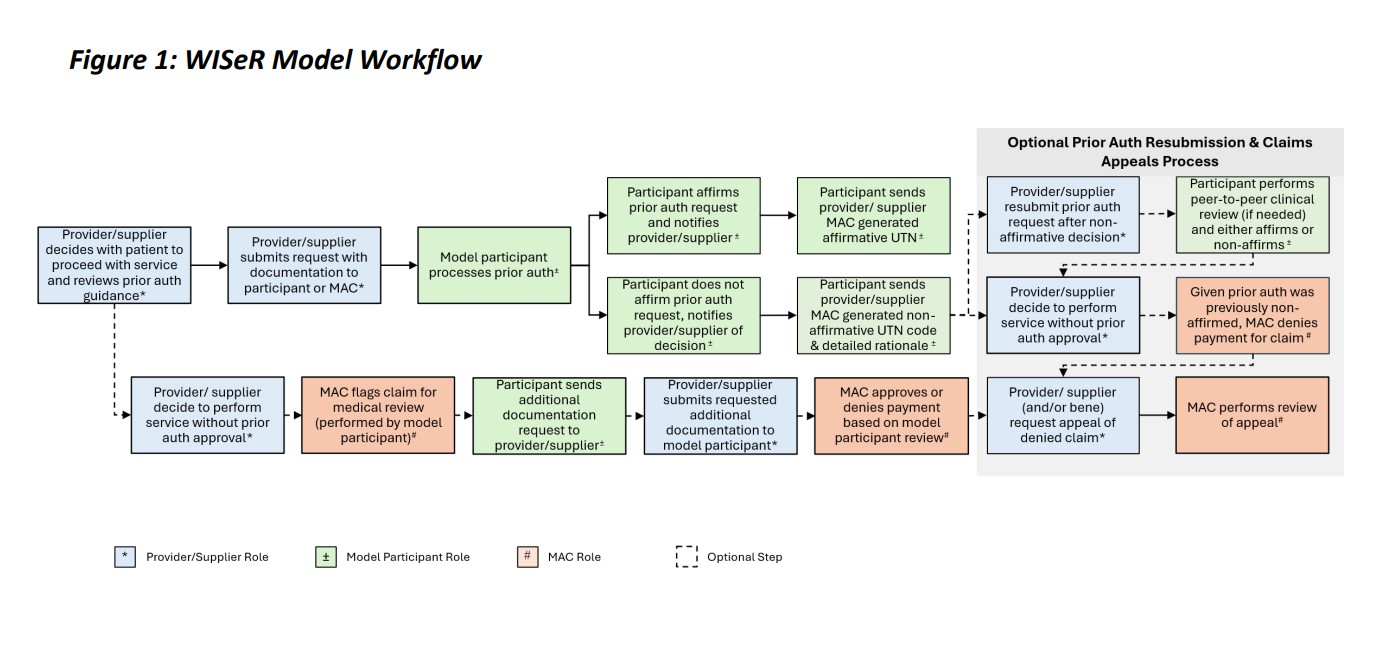
Source: CMS, Wasteful and Inappropriate Service Reduction (WISeR) Model Provider and Supplier Operational Guide, Version 3.0 (last updated Dec. 23, 2025).
Who are the “model participants” and how do they get paid?
CMS selected six technology companies as “model participants,” which it describes as companies with demonstrated success in managing prior authorization processes with enhanced technology for other payer/health plans (such as Medicare Advantage plans).[4] While Medicare administrative contractors (MACs) will continue to fulfill their existing roles, the model participants will perform the prior authorization and prepayment medical review functions under WISeR.
Model participants will receive an incentive payment that is tied to a percentage of the savings associated with a demonstrated reduction in spending arising from WISeR. CMS believes that model participants will not be incentivized to deny prior authorization requests; instead, their incentives are to get the determination right the first time and provide the determination in a clear and timely manner. CMS will monitor denials and, if deficiencies are identified, CMS will decrease payments to the model participant and may remove the participant from WISeR.
When exactly did WISeR start?
WISeR launched on January 1, 2026, and the WISeR model participants began accepting prior authorization requests for WISeR select services and items on January 5, 2026, for services rendered on or after January 15, 2026. Recently posted FAQs discuss the operational status of the WISeR electronic portals.[5]
A note about codes
Appendix A of the WISeR Provider and Supplier Operational Guide identifies the items and services subject to prior authorization or pre-payment medical review. Appendix B of this Guide contains codes for certain “associated” items and services. The Appendix B items and services will not undergo prior authorization if the primary service was submitted for prior authorization or the claim was approved. However, the Appendix B items and services will be denied if the primary service was not affirmed through prior authorization or if the claim was denied.[6] CMS asserts that the associated codes will not be flagged for review unless there is also a primary code on the claim form and that primary code is not affirmed.
Is there any way out of the “voluntary” WISeR program?
For Providers, the short answer appears to be no. The program’s description by CMS as “voluntary” only refers to the voluntary participation by the model participants (i.e., the technology companies performing the prior authorization and pre-payment reviews).
All Providers in the impacted states must participate in WISeR. A Provider’s only choice is whether to submit a request for prior authorization for selected services/items to a WISeR participant or allow the MAC to route the claim to a WISeR participant to conduct pre-payment medical review.
According to CMS, it is exploring a “gold carding” program in the future that would create an exemption from the prior authorization requirement for Providers who achieve certain thresholds for affirmations of prior authorizations.
Key takeaways
- Providers in the impacted states will be required to submit prior authorization through the WISeR participants (or the applicable MAC) or be subject to a pre-payment medical review for the select services and items.
- Appeals are only available if a Provider performs the service and submits a claim after receiving an unfavorable or non-affirmation prior authorization decision or after pre-payment review denial.
- In the not-so-distant past, CMS audits paid based on contingency fees caused denials, which resulted in a significant backlog of claim appeals. In the event that WISeR creates similar incentives for denials, the same result could occur here.
- Pending legislation (H.R. 6361 – “Ban AI Denials in Medicare Act”) introduced on December 2, 2025, seeks to prohibit the implementation of WISeR and any other future CMS Center for Medicare & Medicaid Innovation model that tests prior authorization (including through the use of AI) under traditional Medicare. If this legislation passes in current form, WISeR could be canceled.
DLA Piper will continue to monitor developments concerning WISeR. For more information about these developments, please contact your DLA Piper relationship partner, the authors of this alert, or any member of our Healthcare regulatory practice group.
[1] CMS, Center for Medicare & Medicaid Innovation, Innovation Models, WISeR, WISeR Model Office Hour Video, https://www.youtube.com/watch?v=CATxta1fFu4.
[2] CMS, Center for Medicare & Medicaid Innovation, Innovation Models, WISeR, WISeR Model Slides, https://www.cms.gov/files/document/wiser-oh1-slides.pdf. “UTN” means unique tracking number, which is generated by the WISeR model if the prior authorization request is affirmed.
[3] The full list of items and services is currently located in the WISeR Model Provider and Supplier Operational Guide: https://www.cms.gov/files/document/wiser-provider-supplier-guide.pdf. The WISeR Model Provider Factsheet is located here: https://www.cms.gov/priorities/innovation/files/wiser-provider-fact-sheet.pdf. For Skin and Tissue Substitutes, CMS notes that WISeR is only applicable to selected WISeR MAC jurisdictions and states with an active LCD in place during the WISeR program years starting on January 1, 2026, as of November 21, 2025. As of the publication date of this alert, this would only include JH Novitas and J15 CGS.
[4] More information about the model participants can be found on the CMS WISeR website: https://www.cms.gov/priorities/innovation/innovation-models/wiser.
[5] WISeR Model Frequently Asked Questions, https://www.cms.gov/priorities/innovation/files/document/wiser-model-frequently-asked-questions.
[6] The WISeR Model Provider and Supplier Operational Guide is located here: https://www.cms.gov/files/document/wiser-provider-supplier-guide.pdf.