
24 August 2026 • 15 minute read
US–China life sciences policy developments: Top points for companies
Recent United States policy developments reflect a broader effort by policymakers and regulators to reduce strategic dependencies on China across the biopharmaceutical sector.
This alert summarizes key developments affecting biopharmaceutical companies, with a particular focus on US–China regulatory and national security measures. Each section identifies a recent development, its practical implications, and potential next steps for companies.
1. 1260H list expansion and BIOSECURE Act implications
On June 8, 2026, the US Department of Defense (DoD) released its annual update to the Section 1260H Chinese Military Companies list, expanding it to 188 entities, including WuXi AppTec.
Under the BIOSECURE Act, enacted on December 18, 2025 as part of the Fiscal Year (FY) 2026 National Defense Authorization Act (NDAA), 1260H-listed entities that are involved in the manufacturing, distribution, provision, or procurement of biotechnology equipment or services are automatically subject to designation as Biotechnology Companies of Concern (BCCs). The Office of Management and Budget (OMB) is required to publish its initial list of designated BCCs by December 18, 2026. Once designated, phased restrictions will apply to federal procurement, contracts, grants, and loans involving the use of a BCC’s biotechnology equipment or services.
WuXi AppTec challenges its 1260H designation
On June 11, 2026, WuXi AppTec filed suit in the US District Court for the District of Columbia, challenging its 1260H designation. On August 7, 2026, the court issued a preliminary injunction barring DoD from enforcing or giving effect to the designation while the case proceeds.
DoD’s designation relied in part on its finding that the Aviation Industry Corporation of China (AVIC), a state-owned enterprise overseen by the State-Owned Assets Supervision and Administration Commission of the State Council (SASAC), held a 5.32-percent equity interest in WuXi AppTec through the AVIC Military-Civilian Integration Selected Fund. Based on this, the government argued in litigation that “an entity owned by SASAC ‘itself owns more than 5 percent of WuXi's equity.’”
Section 1260H does not specify a percentage threshold for ownership. The statute requires that the entity be “directly or indirectly owned by, controlled by, or beneficially owned by, affiliated with, or in an official or unofficial capacity acting as an agent of or on behalf of” certain Chinese military and state entities.
DoD’s argument rested on the premise that an ownership stake of more than five percent was sufficient to establish that WuXi AppTec was owned by a Chinese military company. Further review found that WuXi AppTec holdings accounted for 5.32 percent of AVIC’s portfolio rather than AVIC owning 5.32 percent of the total company.
AVIC’s actual ownership interest was approximately 0.001 percent of WuXi AppTec’s equity, represented by about $200,000 in publicly traded shares purchased on the open market, which the court concluded did not reasonably constitute “ownership” of the company.
Navigating the WuXi AppTec listing
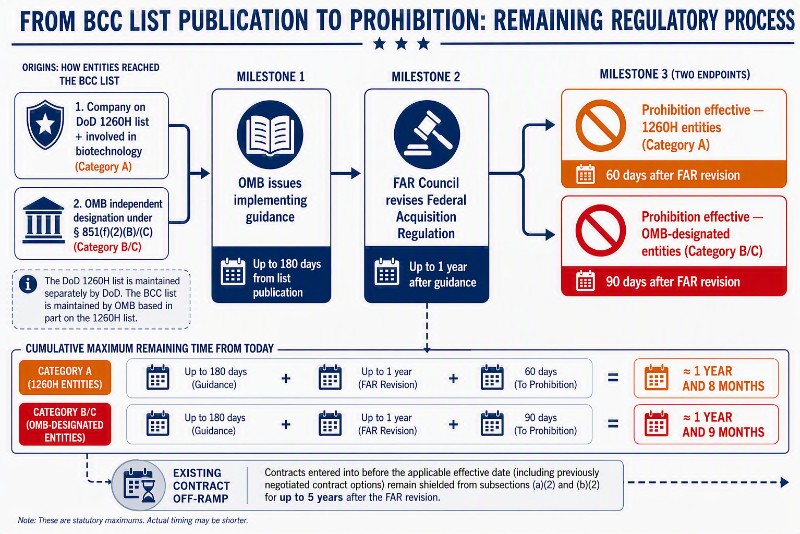
While the resulting injunction will almost certainly delay any possible designation of WuXi AppTec as a BCC through the 1260H pathway, companies that rely on WuXi AppTec or other Chinese contract development and manufacturing organizations (CDMOs) to manufacture their drugs are encouraged to consider the timeline between a CDMO’s designation as a BCC and the point at which executive agencies are prohibited from procuring products or services from that company.
1. A biotechnology company becomes a BCC through one of two pathways:
- The company is identified on the DoD’s 1260H list of Chinese military companies operating in the US and separately determined to be involved in the manufacturing, distribution, provision, or procurement of biotechnology equipment or services, or
- The company is independently designated by OMB as a BCC because it is subject to the administrative governance structure, direction, or control of, or operates on behalf of, the government of a foreign adversary.
2. Once OMB publishes or updates its list of biotechnology companies of concern to incorporate that entity, it must establish implementing guidance in coordination with other agencies no later than 180 days after the publication or update.
3. Next, the Federal Acquisition Regulatory Council must revise the Federal Acquisition Regulation (FAR) as necessary to implement the section’s requirements no later than one year after that guidance is established.
4. Once the FAR is revised, the procurement prohibition will take effect 60 days later for entities identified through the 1260H list pathway, or 90 days later for entities identified through the independent OMB designation pathway.
Absent the court’s injunction, a BCC designation for WuXi AppTec could have occurred in early 2028. Companies designated solely through OMB's listing process are generally eligible for a five-year transition period to wind down pre-existing contracts with biotechnology companies of concern. By contrast, if a company is already included on DoD's Section 1260H list when the FAR is revised, the contracting restrictions take effect after 60 days.
Because WuXi AppTec was added to the 1260H list in June 2026, prior to any FAR revision, existing contracts involving its services could face the compressed 60-day timeline rather than the five-year transition, unless the preliminary injunction issued on August 7, 2026 ultimately results in a reversal of that designation. This raises two related questions:
1. If the injunction remains in force when the FAR is revised, does WuXi AppTec trigger the 60-day implementation period applicable to companies already listed under Section 1260H? One view may be that, if WuXi AppTec’s designation is not reversed and the injunction remains in force when the FAR is revised, WuXi AppTec should not be treated as a company already listed under Section 1260H because doing so would give effect to the designation despite the court’s order. Under that interpretation, WuXi AppTec would not trigger the 60-day accelerated timeline, and pre-existing contracts would fall within the default five-year grandfather provision. Another view may be that WuXi AppTec remains formally on the 1260H list because the injunction prevents enforcement of the designation, not its existence.
2. To whom does the 60-day rule apply? The statute denies the five-year transition period to contracts involving 1260H-listed companies, but it is unclear what constitutes involvement. It is also unclear whether that term reaches only direct contracts between the federal government and the listed entity or extends to customers that contract with the listed entity under separate agreements. The FAR revision and OMB’s implementing guidance, both still forthcoming, could resolve this ambiguity and determine whether downstream pharmaceutical customers with pre-existing CDMO contracts are also eligible for the five-year transition period.
Next steps
Companies with existing CDMO or contract research organization (CRO) relationships with WuXi AppTec, its affiliates, or other Chinese entities may wish to:
- Conduct supply chain mapping now to identify potential exposure
- Assess whether any federal contracts, grants, or loan-supported programs intersect with services provided by potentially designated entities
- Begin evaluating alternative manufacturing and research partners, recognizing that site transfers require Good Manufacturing Practice revalidation and Food and Drug Administration (FDA) approval – a process that can sometimes take years
Reimbursements
The prohibitions in subsections (a) and (b) are framed in terms of executive agency procurement and contracting and the use of loan or grant funds. The term “contract” is defined narrowly to mean either a contract subject to the FAR or an “other transaction” under 10 U.S.C. § 4021. Neither Medicare Part D reimbursement, which flows through private prescription drug plan sponsors, nor Medicare Part B reimbursement for physician-administered drugs is structured as a FAR-governed procurement contract or an “other transaction” under that definition. A plain reading of the statutory language suggests that designation as a BCC does not directly affect Medicare Part B or Part D reimbursements because those payment mechanisms fall outside the narrow definitions of “contract” and “procurement” that trigger the prohibition. Nevertheless, the statute delegates authority to OMB to issue implementing guidance and to the FAR Council to revise regulations, so the ultimate scope of the prohibition’s reach into Medicare reimbursement channels will depend in part on how those bodies interpret and implement the BIOSECURE Act.
2. China’s response
In April 2026, China's State Council issued two regulations that could affect how companies respond to the BIOSECURE Act's restrictions on Chinese biotechnology companies:
- The Counter-Extraterritorial Jurisdiction Regulation allows the Chinese government to take “necessary measures” against any party that complies with foreign measures restricting their business with Chinese entities.
- The Supply Chain Security Provisions limit information gathering on Chinese supply chains, which could complicate pharmaceutical companies’ due diligence efforts as they assess their exposure under the BIOSECURE Act.
Together, these regulations could present challenges for companies assessing their supply chain exposure, evaluating supplier relationships, and implementing transition plans.
Additionally, on June 22, 2026, China’s Ministry of Commerce (MOFCOM) and Ministry of Finance (MOF) imposed restrictions on 56 US entities. MOFCOM placed ten US firms – primarily in defense and rare earths, including MP Materials – on China’s export control list, barring Chinese exports of military-use products to those entities. MOF excluded 46 US companies from Chinese government procurement.
Notably, while they did not place restrictions on US life sciences companies in this round, the moves by MOFCOM and MOF demonstrate China’s willingness to weaponize export controls in adjacent sectors. China’s own outbound investment regulations took effect on July 1, 2026, and Chinese regulators retain the option of adding biotechnologies to their Catalogue of Technologies Prohibited and Restricted from Export.
Next steps
Pharmaceutical companies may face competing compliance considerations arising from the BIOSECURE Act and China’s evolving regulatory framework. Companies with commercial operations in China may wish to:
- Review transaction structures, governing-law provisions, termination clauses, and dispute-resolution mechanisms in agreements with Chinese partners, particularly where compliance obligations under US and Chinese law may diverge;
- Monitor whether future export controls include pharmaceutical or biotechnology services;
- Assess exposure to potential Chinese export controls on biological materials, reagents, or proprietary data held by Chinese partners;
- Advocate for generous interpretations of transition periods under the BIOSECURE Act and implementation guidance from OMB that accounts for the fact that disengagement carries its own legal and operational risks that the statute does not contemplate.
3. BINSA and proposed expansion of outbound investment controls to biotechnology
On June 2, 2026, US Representatives John Moolenaar (R-MI) and Debbie Dingell (D-MI) introduced the proposed Biotech Investment National Security Act (BINSA), H.R. 9102. If enacted, BINSA would add “biotechnology” to the list of prohibited and notifiable technologies under the Comprehensive Outbound Investment National Security Act (COINS Act), which became law as part of the FY 2026 NDAA.
BINSA’s definition of “biotechnology” encompasses:
- Research, development, manufacturing, or commercialization of all “drugs” (as defined in the Federal Food, Drug, and Cosmetic Act) and all “biological products” (as defined in the Public Health Service Act)
- Drug discovery platforms, clinical research and development capabilities, biologics manufacturing, and intellectual property licensing and know-how
BINSA would also add licensing arrangements to the types of covered transactions subject to outbound investment controls, directly implicating the in-licensing deals through which many US pharmaceutical companies access Chinese-developed compounds.
Separately, Representative Moolenaar sent a letter to US Department of the Treasury (Treasury) Secretary Scott Bessent on May 21, 2026, requesting that Treasury exercise its existing regulatory authority under the COINS Act to add biotechnology without new legislation. Treasury’s implementing regulations for the COINS Act are due by March 13, 2027.
Next steps
Companies with pending or contemplated licensing deals involving Chinese biotechnology firms may wish to:
- Evaluate whether those transactions could qualify as “covered national security transactions” under BINSA’s framework
- Monitor Treasury’s rulemaking process for the COINS Act; even absent BINSA’s enactment, Treasury has discretionary authority to expand covered technology categories
- Consider structuring new China-origin licensing deals with contingency provisions addressing potential future regulatory restrictions
4. FDA appropriations proposals: Signal on foreign clinical trial data
On April 29, 2026, the House Appropriations Committee advanced its FY 2027 Agriculture/FDA spending bill. The accompanying committee report includes language that would prohibit FDA from “accepting, reviewing, or considering” clinical trial data generated at sites in China, Russia, Iran, or North Korea in support of Investigational New Drug (IND) applications. The restriction would take effect one year after enactment.
This language appears in the committee report rather than the text of the bill itself, meaning the report language itself would not carry the force of law even if the bill were enacted in its current form.
Next steps
Sponsors with development programs that include or contemplate China-based clinical sites may wish to:
- Evaluate contingency plans
- Supplement, where feasible, existing INDs with non-China clinical data to reduce vulnerability to future regulatory action
- Structure development plans for new programs to avoid sole reliance on clinical trial data from covered nations
5. Operation TrialBlazer: HHS initiative to restore US clinical research leadership
On June 22, 2026, the US Department of Health and Human Services (HHS) launched Operation TrialBlazer, a coordinated department-wide initiative to reverse the growing shift of early-stage clinical research overseas. The initiative is led by FDA, the National Institutes of Health, the National Cancer Institute, the National Center for Advancing Translational Sciences, and the Advanced Research Projects Agency for Health.
The initiative comes in the wake of China surpassing the US in global share of Phase 1 trials in 2021 and in total registered clinical trials in 2024. Phase 1 trials in China average seven months versus 17 or more in the US, at 32- to 52-percent lower cost. The HHS roadmap explicitly frames this trend as both an economic competitiveness and national security concern. At the same time, while there is a steady uptick in sponsors initiating their first-in-human trials in China, 89 percent of Phase 1 trials in China in 2025 were initiated by Chinese entities, with only five percent coming from the US and EU.
Key components
- Expedited IND Pilot Program: FDA has proposed a rolling, institution-partnered IND submission model through Qualified Research Institutions (i.e., academic medical centers, CROs, or healthcare networks). The pilot aims to shorten time from drug identification to first-in-human study.
- Streamlined Phase 1 Chemistry, Manufacturing, and Controls (CMC) expectations: Updated guidance clarifies phase-appropriate CMC requirements, potentially saving sponsors six to 12 months of development time by discouraging over-submission of manufacturing data at the IND stage.
- Quantitative Systems Pharmacology (QSP) dose selection: New draft guidance supports computational modeling approaches (e.g., QSP-based minimum anticipated biological effect level) to guide first-in-human dose selection, reducing reliance on traditional animal toxicology studies.
- Single pivotal trial flexibility: Revised draft guidance clarifies that one adequate, well-controlled pivotal trial with confirmatory evidence may be sufficient to establish substantial evidence of effectiveness in many settings.
- PreCheck Pilot Program: The PreCheck Pilot Program is a voluntary FDA program for companies building new US manufacturing facilities, allowing earlier regulatory engagement. FDA announced seven participants on June 29, 2026.
- Institutional Review Board reform and trial access: FDA is pursuing reforms to reduce administrative burdens in clinical trial activation, including efforts to improve patient enrollment and expand compensation for trial participants.
Next steps
Sponsors with early-stage assets may wish to:
- Evaluate whether the Expedited IND Pilot Program, once finalized, could accelerate their development timelines
- Review Phase 1 IND submissions for opportunities to streamline CMC packages in light of updated FDA expectations
- Apply for the PreCheck Pilot Program if building or planning US manufacturing facilities
- Assess whether Operation TrialBlazer’s incentives to conduct trials domestically alter the cost-benefit analysis for programs currently planned for China-based sites
Summary and outlook
The developments above reflect the use of multiple policy tools directed at reducing US pharmaceutical dependence on China. These include procurement restrictions under the BIOSECURE Act, investment controls under the COINS Act and BINSA, clinical data restrictions reflected in FDA appropriations proposals, potential tariff measures under Section 232 of the Trade Expansion Act of 1962, bilateral designations, and domestic research and manufacturing initiatives such as Operation TrialBlazer.
Companies with China-facing supply chains, licensing relationships, or clinical development programs are encouraged to consider advancing compliance planning, proactively restructuring supply chains, and drafting deal terms that account for evolving regulatory developments and carry the appropriate contingencies.
For more information, please contact the author.