
23 February 2026
When Success Becomes a Risk: Lessons from Dryrobe Limited v Caesr Group Limited [2025] EWHC 3167 (IPEC)
Every brand aspires to become a household name, but that level of success can often carry hidden risk which can undermine the very influence that the brand seeks to build. The recent decision from the High Court (IPEC) in Dryrobe v Caesr Group (t/a D-Robe Outdoors) offers a timely reminder of the necessary balance between popularity and distinctiveness and illustrates the legal seldom-litigated concept of genericide.
The background
The Claimant (Dryrobe) is the owner of the DRYROBE brand and is a market leader in outdoor changing robes, while the Defendant (D-Robe) is a competitor selling similar products under the D-ROBE brand.
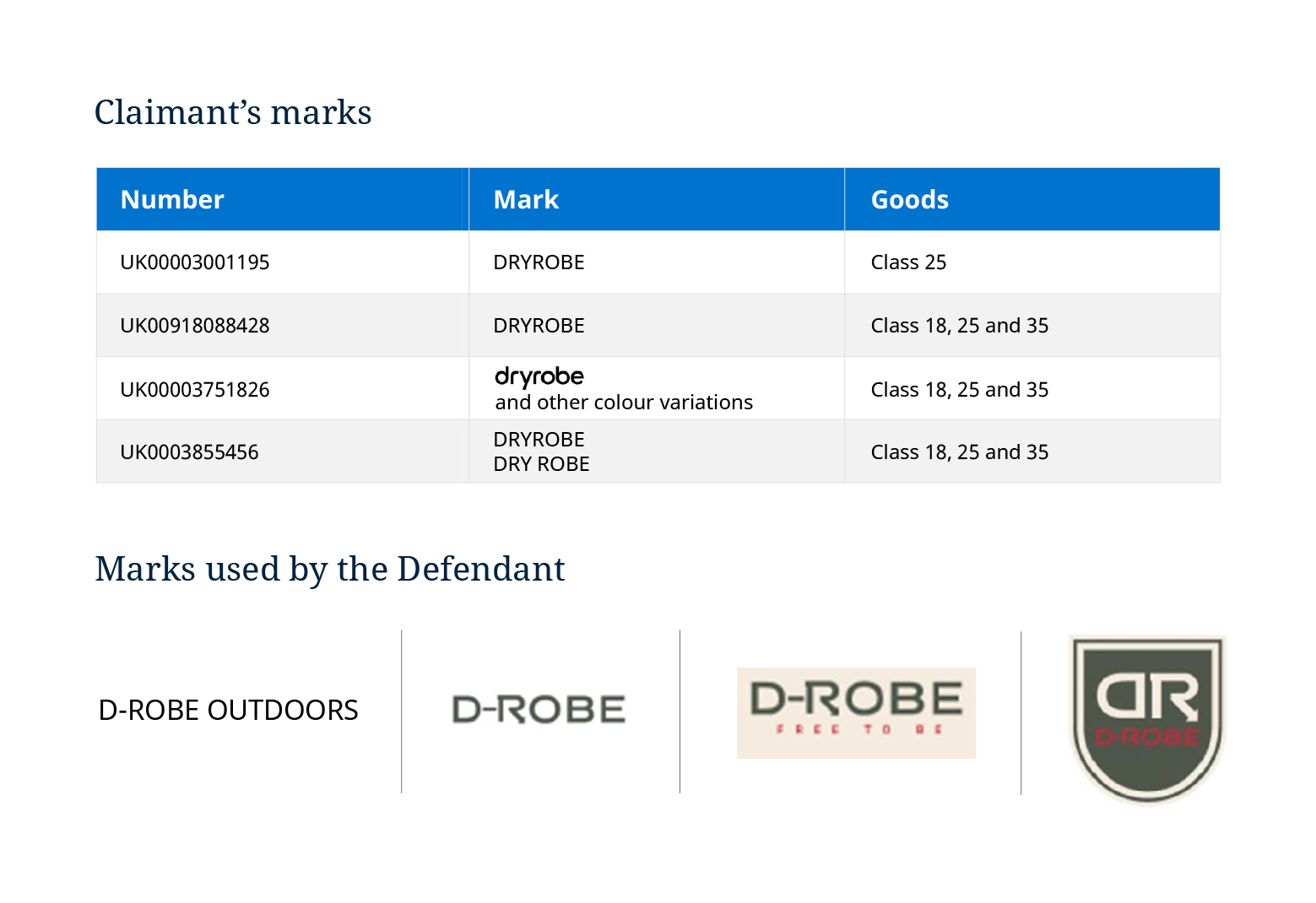
Dryrobe brought a claim of trade mark infringement under sections 10(2) and 10(3) of the UK Trade Marks Act 1994 (the Act), in addition to a passing off claim. D-Robe brought various counter-claims, stating that DRYROBE is descriptive, non-distinctive, and customary in the trade under ss3(1)(b)-(d) of the Act and sought revocation on the grounds of genericism (due to the acts or inactivity of Dryrobe) and non-use under ss46(1)(a) and (c) of the Act.
Descriptiveness
The court found that DRYROBE is descriptive of certain types of robes, as well as beach wraps and various clothing such as waterproof, sports and beach clothing. In making this finding, the judge held that DRYROBE is descriptive of at least one of the characteristics of the goods and highlighted that it does not matter that DRYROBE could be understood by consumers to have other, non-descriptive meanings.
Unsurprisingly, the judge held that DRYROBE was not descriptive for goods such as bags and hats as “The descriptive element of the mark (DRY) when combined with the non-descriptive element ROBE (in the context of bags and hats) means the mark DRYROBE has no descriptive meaning in relation to such goods”.
Acquired distinctiveness
Dryrobe successfully argued that the DRYROBE brand had, despite its inherent descriptiveness, acquired distinctiveness through the extensive use made of the brand in the marketplace. It presented evidence of sales volumes and the dominant appearance of the marks on the garments themselves, which act as a form of consumer-facing advertising. Also, Dryrobe's impressive market position, the volume of media coverage for DRYROBE as a brand and the large sums spent on marketing all pointed favourably to the fact that DRYORBE had acquired a secondary meaning as a brand. The evidence of actual confusion by consumers also helped to prove that consumers view DRYROBE as a brand.
The judge summarised this succinctly: “I have found that by the relevant date it has acquired distinctiveness which it did not have inherently, being descriptive, and that distinctiveness is its ability to function as a trade mark to distinguish the goods and services of one undertaking from those of other undertakings”.
Genericism
The Defendant sought to challenge Dryrobe's trade marks under sections 3(1)(b) and 46(1)(c) of the Act, which allows a trade mark to be cancelled/revoked if it has become a common name for the goods in the trade. However, the Claimant had already identified this risk during the course of its business and had taken proactive steps to combat generic use of the DRYROBE mark. It had budgeted for brand enforcement work and actively conducted brand protection measures, such as informing third parties of its IP rights in DRYROBE and suggesting amendments to third party product descriptions which referenced 'dry robes'.
The Claimant also used social media to emphasise the genuine DRYROBE product and educated third parties on how to use the mark with the ® symbol to refer to the brand. Dryrobe kept documentary evidence of the work done internally and externally, leaving the judge “satisfied that the Claimant had since 2019 regularly, systematically and consistently been searching for, and challenging, use of ‘dryrobe’ as a category term on social media and in the press”.
The judge also accepted that “it does not follow from the mere fact that a section of the relevant public uses a mark generically in the relevant period means that it has become customary so that it is incapable of functioning as a trade mark“. The widespread use of GOOGLE by consumers was a helpful illustration of this; it is used as a verb to describe an internet search but remains a strong indicator of origin.
Likelihood of confusion
The judge held that there was a likelihood of confusion between DRYROBE and D-ROBE due to the medium to high degree of similarity between the signs (with D-ROBE potentially being viewed as a shortened, summarised version of DRYROBE), the identity of the goods at issue and evidence of actual direct and indirect consumer confusion.
While the judge was “willing to accept that customers may at times be merely inattentive or make mistakes… in [her] judgment the evidence does not support either of these contentions as being a common or significant issue in this case”.
In defence, D-Robe argued that the average consumer would understand D-ROBE to mean 'derobe', i.e., to take off a robe, offering a point of conceptual differentiation, but the judge was not convinced by this line of argument as it is “everyday language used by the average consumer) to describe somebody as disrobing, not derobing”.
D-Robe also suggested that Dryrobe needed to accept some level of consumer confusion due to its conscious choice to adopt a weak indicator of origin as a brand name. The judge dismissed this line of argument and upheld the Claimant's infringement claim under section 10(2) of the Act.
Reputation and resulting damage
It was accepted that the Claimant's marks had established a reputation through the same impressive evidence of acquired distinctiveness that it had filed. The Claimant argued the volume of sales, market position, volume of media coverage, marketing spend, and public reviews showed an impressive reputation in the marketplace.
Dryrobe had spent significant sums on advertisements which regularly generated over 2.5 million impressions and its Instagram page had over 100,000 followers. The branded DRYROBE goods had also won many awards, and the Claimant built a community around the brand through ambassadors and influencers who promoted its products. This relationship is shown through partnerships with Team GB during Olympic Games and with Red Bull.
Additionally, D-Robe disclosed documentation which evidenced actual wrong-way confusion where consumers contacted the Defendant about Dryrobe's products. This amounted to unfair advantage and exploitation by the Defendants of Dryrobe's marketing and advertising efforts, harming the Claimant's business and damaging its reputation.
Passing off
The judge was satisfied that the elements of passing off were made out. Sufficient goodwill was generated in the DRYROBE marks; the ordinary consumer would believe the D-ROBE goods are associated with the Claimant; and damage was made out because there had already been actual consumer confusion.
Key takeaways
This decision is significant as it shines a light on the issue of genericide, a term used to describe the scenario where a brand name functions as the known name of a product rather than the brand behind the product, such as Hoover.
Brands should take heed – it takes proactive and systematic work to maintain the distinctive character of a trade mark where the brand has become a household name. Companies need to monitor for genericide and invest in educating consumers on their exclusive IP rights, as well as how to correctly refer to the brand in the trade mark sense.
For up-and-coming brands to avoid these risks, it is preferable to include a distinctive element within the name, and thereafter to ensure budget is allocated for brand enforcement and monitoring as the business grows.