
29 July 2026 • 14 minute read
Digital Markets Champion First Report: Establishing a framework for the development of a tokenised wholesale financial markets system in the UK
Recent developments in digital assets within the UKDigitalisation of the UK’s financial and capital markets is breaking out into the mainstream of policy thinking and industry conversation. The UK processes over GBP4 trillion worth of securities on average per day and is well placed to benefit from digitalisation, but without a coordinated roadmap it risks losing ground as standards and infrastructure evolve offshore. The tokenised real-world assets market is projected to reach USD88 trillion by 2035, and analysis by Barclays and PwC suggests tokenisation could increase annual UK economic output by up to GBP33 billion and annual tax revenues by GBP14 billion by that date.
UK policymakers are sensitive to these opportunities and there has been a rapid expansion of proposals in the post-Brexit era to steer the UK on a growth path around the promise of new technological developments. These include:
- The DSS (digital securities sandbox) regime, introduced in 2023 by HM Treasury via The Financial Services and Markets Act 2023 (Digital Securities Sandbox) Regulations 2023 to permit entities approved by the Bank of England to use digital technologies in ways which might otherwise have conflicted with applicable existing laws, which were not written with DLT in mind, or the application of which was in some respects uncertain.
- The DIGIT (digital gilt) initiative, which HM Treasury announced in July 2025 in its policy paper, “Digital Gilt Instrument (DIGIT) pilot update” and pursuant to which it intends to issue a digitally native short-dated gilt with on-chain settlement of both the asset and the cash payment, to enable settlement of secondary market (OTC) trades, to foster interoperability with the traditional (non-digital) gilt investment markets, and to provide “greater transparency” about ownership.
- The May 2026 joint Call for Input from the FCA and the Bank of England, containing a comprehensive list of what they are doing to explore and encourage the “tokenisation” of assets and cash in the UK’s wholesale financial markets.
- The June 2026 revised proposals from the Bank of England on the use of stablecoins in the financial markets, following on from its November 2025 consultation paper about a regulatory regime for GBP-denominated systemic stablecoins (by “systemic” it means stablecoins which are used as the digital settlement asset by a payment system or service provider that is recognised by HMT as systemic). For further detail, see our briefing, “The future of tokenisation: A joint vision from the UK authorities for wholesale financial markets”.
- The July 2026 policy paper, “UK-US Joint Statement on Stablecoins”, which sets out ten shared principles with a view to promoting convergence between the two regimes.
- HM Treasury’s July 2026 open consultation on “Modernising Payment Services Regulation”, in the context of what it describes as a future “multi-money” ecosystem involving fiat currency, tokenised deposits and stablecoins.
The latest development is the publication of the Woolard report. Last summer, HM Treasury announced the role of a Wholesale Digital Markets Champion to accelerate digitalisation of the market, and Chris Woolard, who had previously served as the FCA’s interim CEO, was appointed to the role in April 2026. His brief is to establish a cross-industry taskforce with representatives across the market ecosystem, promote the delivery of the UK government’s Wholesale Financial Markets Digital Strategy across the sector and showcase the UK as a “digital assets centre globally”. In co-ordination with the chairs of the Accelerated Settlement Taskforce (AST) and Dematerialisation Market Action Taskforce (DEMAT) he will report to the Chancellor about:
- how UK wholesale markets can best adopt tokenisation and other related technologies; and
- how to ensure Distributed Ledger Technology (DLT) interoperability.
The 71-page first report was issued last week after over 70 meetings and roundtables with market firms, international standard-setting bodies and trade associations. This report sets out a 12-month plan to kick-start the adoption of tokenisation in the financial markets, involving coordinated action between HM Treasury, the Bank of England, the FCA, Prudential Regulation Authority and the industry. A second report in a year’s time is intended to review progress, and in the meantime there is going to be a great deal of activity.
In line with the recent Call for Input by the FCA and the PRA and the DSS regime, the role of the Wholesale Digital Markets Champion underpins a growing co-ordination between the public and private sectors in the UK for industry experimentation, digital asset promotion and product initiatives with regulatory support and oversight.
Wholesale Digital Markets Champion – Taskforce's Action Groups
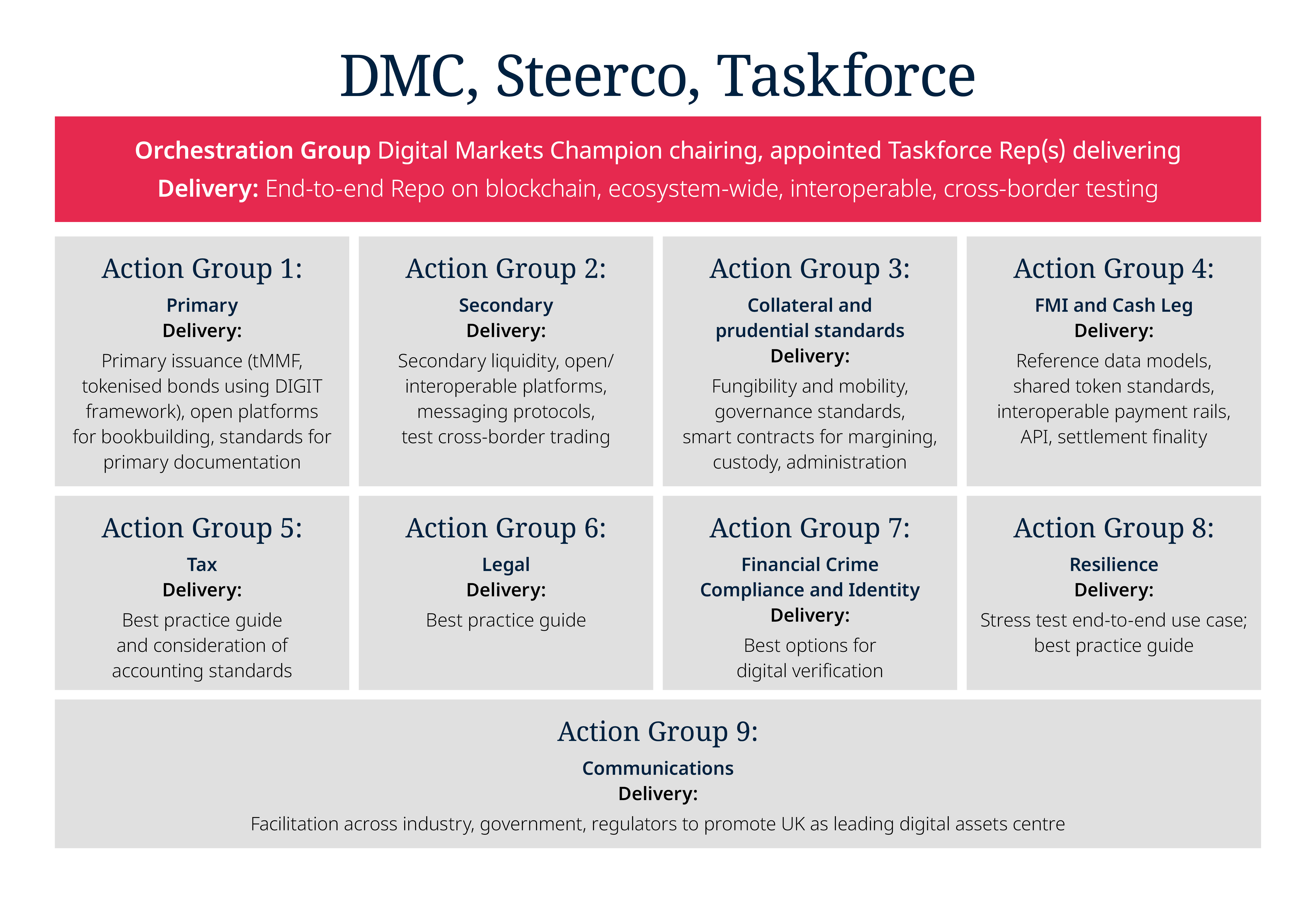
More than fifty firms drawn from across the finance industry have contributed members to the Digital Markets Champion Industry Taskforce, which is intended to drive progress over the next 12 months. The taskforce is setting up nine action groups which convene industry experts, details of which appear below. These will feed up to Chris Woolard and his eight-person steering committee. The action groups' responsibilities are, in short, as follows:
AG1–AG4 focus on the transaction value chain: primary issuance and funds, secondary markets, collateral and prudential standards, and FMI/cash infrastructure — developing interoperable platforms, token standards, smart contracts and settlement processes.
AG5–AG8 provide horizontal support across tax, legal, financial crime compliance and resilience, producing best practice guidance and stress-testing end-to-end use cases.
AG9 (Communications) will coordinate promotion of the UK as a digital assets centre, including "myth-busting".
An "Orchestration Group" (OG) chaired by the Digital Markets Champion will coordinate the practical delivery and oversee the development of the end-to-end repo use case on blockchain, ensuring ecosystem-wide interoperability and cross-border testing. The Orchestration Group will also ensure alignment across Action Groups, encourage knowledge sharing, and commission cross cutting input.
The following schematic illustrates the way the taskforce is organized:
Industry actions
Chapter 7 of the report, entitled “Priorities, recommendations and roadmap”, identifies the value that lies not merely in tokenising existing instruments but in the emergence of digitally native and programmable asset classes. It recommends an early focus on the UK’s existing strengths, including fixed income, FX and commodity trading, wholesale settlement, asset management, repo and collateral management, custody, and audit and compliance tooling, with particular emphasis on secondary markets and post-trade infrastructure in order to target the most important benefits including liquidity, price formation, efficient capital utilisation, capital mobility and cross-border flows, issuance and scalability.
It identifies ten key priorities, each with corresponding industry actions and supporting regulatory actions, and allocates responsibility for each of these among the action groups. In short:
- Scalable, live, tokenised markets – The OG and AGs 1 and 2 are tasked with building on the DIGIT pilot to develop an ecosystem for digital securities, developing standards for open, interoperable platforms, and delivering and validating end-to-end tokenisation use cases focusing on repo, fixed income and uncleared OTC derivatives. HM Treasury is prioritising an immediate pilot issuance of DIGIT no later than Q1 2027, with more over the medium term, including live secondary market trading.
- Tokenised collateral – AG3 is asked to build collaborative ecosystem solutions from bilateral use cases and validate the end-to-end repo use case to support scaling. The Bank of England aims to accept DIGIT as collateral in the Sterling Monetary Framework, and will consider broader acceptability of tokenised collateral e.g. for use in central counterparties (CCPs).
- Tokenised funds – AG 1-3 are, through the Investment Association’s IF3 Lab, to establish common operational and market practices and develop funds use cases. The Government and Authorities will maintain close engagement with industry and provide guidance as needed.
- Wholesale payment rails – AG4 is to work on continuing to build the GBTD (the “Great British Tokenised Deposit”, a UK industry initiative led by UK Finance to develop and test tokenised sterling commercial bank deposits) at scale, to develop end-to-end tokenisation use cases that work across both existing and new payment rails, shared token standards, common APIs and data models (including through the Common Domain Model) to deliver interoperability. The Government and Authorities are asked to ensure infrastructure and regulatory policy towards settlement of tokenised assets using different forms of money (including stablecoins and tokenised deposits) and to develop models to allow settlement directly in central bank money via RTGS.
- Legal certainty – AG6 is tasked with developing best practice frameworks under English law (eg ICMA’s digital Bond Data Taxonomy), identifying any blocking issues and raising them with the Authorities, and promoting English law’s ability to adapt to innovation and developing “myth-busting narratives”. The Government and Authorities have been asked to support industry where greater certainty is required.
- Regulatory standards – AG3 is asked to collaborate with HM Treasury and other relevant authorities to identify regulatory pinch-points. The Government and Authorities have been asked to ensure that the UK regulatory regime provides comprehensive support for digital innovation.
- Interoperability standards – AG1-4 are to lead on the development of domestic interoperability standards including APIs, messaging protocols, reference data models, data standards and governance frameworks (inter-operability has emerged as possibly the major obstacle commonly cited, and, whilst the ideal may be a single ledger handling both assets and cash, this kind of single DLT platform handling cash and assets does not yet exist, and in the medium term at least we are likely to see assets on one platform and cash on another, and so will need effective inter-operability between the two). The requested actions from the Government and the Authorities are to support industry-led functional standard setting for interoperability which is in alignment with established regulatory expectations and to take a proportionate and technology neutral principle-based approach to the introduction of new services by financial market infrastructures.
- Financial crime compliance and digital identity – AG7 is to develop solutions and best practice to close the ‘lag’ of any tokenised asset’s compliance data moving between platforms and its associated asset, develop and test interoperable compliance frameworks including safe harbours, and support digital verification. The Government and Authorities have been asked to ensure that financial crime regulations are fit for DLT and to support the development of standards for digital verification and identity.
- Tax neutrality – AG5 is tasked with ensuring technologically neutral tax frameworks through existing working groups, including considering relevant accounting standards (a 2025 20-page position paper from the Investment Association, “Tax Aspects of Tokenisation”, has already (a) spelt out that tokenised assets should be taxed in the same way as untokenised assets and (b) identified various “tax blockages” that could deter tokenisation (and suggested a simple “enablement act” that would embody the principle of equality and neutrality of treatment). The Government and Authorities have been asked to embed tech-neutrality for tax treatment of digital assets into legislation and guidance.
- Resilience – AG8 will deliver a coordinated testing and resilience programme for cross-network components. The Government and Authorities have been asked to adapt existing principles, consistent with their statutory objectives, to underpin resilience in tokenised markets.
Legal issues identified
The report raises several legal issues in relation to tokenisation and DLT as well as areas requiring greater certainty:
Settlement finality — The existing UK regime was built around traditional payment and securities settlement systems and has not been fully adapted for tokenised assets and DLT-based settlement. The DSS makes provision for designation but further clarity on other tokenised assets is needed and would encourage increased adoption of DLT based infrastructure.
Permissionless networks and chain reorganisation risk — On permissionless DLTs, confirmed transactions could theoretically be reversed by chain reorganisation, a risk not addressed by traditional infrastructure or regulations; the law must be calibrated to account for this risk.
Cross-border legal uncertainty — Overseas-issued tokenised assets may carry uncertain legal status for UK investors, particularly where jurisdictions adopt differing legal frameworks (token-specific vs existing law). There are questions as to whether such assets reflect a legal claim or property right.
Dematerialisation of securities — Legislative amendments are required for tokenisation of equities.
Custody and client asset treatment — HM Treasury and the FCA need to finalise policy on custody of digital assets.
Prudential treatment — The PRA has deferred permanent prudential capital and risk management rules until at least 2028 pending the Basel Committee's targeted review of cryptoassets, creating interim uncertainty.
AML/KYC on-chain — Permissionless networks reduce opportunities to confirm identity, with implications for compliance with identity-based requirements; on-chain identity solutions remain in early stages.
No-action letter mechanism — Unlike the US, UK regulators cannot waive statutory requirements through no-action letters; formal legislative modification is required, which the report identifies as a competitive disadvantage in speed-to-market and in relation to lowering barriers to entry.
English law's adaptability — The report notes positively that the Law Commission has found the current framework in England and Wales clearly able to facilitate smart legal contracts without statutory reform, and property rights have been confirmed for digital assets through the Property (Digital Assets etc) Act 2025 (and one might also add here reference to the inherent flexibility of the English common law and the quality of the English judiciary).
Conclusions, next steps and repo use case in 2027
The report's conclusions emphasise the need for "pragmatic and practical action at pace", while positioning the UK as having strong legal foundations but identifies specific gaps — particularly around settlement finality for DLT systems, cross-border legal recognition, and the speed of regulatory authorisation — that require coordinated action to maintain competitiveness against jurisdictions such as the US, Singapore and Switzerland.
The report notes that the next step to achieve scalable, live tokenised markets that drives industry investment is ensuring a clear route out of live sandboxes and testing grounds into at-scale, regulated activity under lasting, permanent regulatory regimes and that broader investor participation will depend on the clarity that is provided in relation to long-term commitments to further issuance, supporting market infrastructure and market conventions.
The report highlights that to support the development of tokenised markets, the UK needs to deliver the scaling of priority use cases to build confidence and develop industry-wide expertise. The repo market trial is an example of a priority use case. Fixed income and OTC derivatives are also highlighted for validating end-to-end tokenisation use cases.
The Wholesale Digital Markets Champion is welcoming further engagement and views on the contents of the report by Friday 4 September 2026 to ensure the proposed programme of work reflects the priorities of the sector as a whole.
Work has already commenced to assemble the action groups across industry, with members and chairs in the process of confirmation; their membership and precise tasks will be finalised by September 2026. Each group will have a detailed timeline with specific deliverables and identified milestones.
Meaningful progress is expected by the end of 2026, with many immediate use cases skewing towards fixed income given its advanced thinking and scale in the UK. A repo use case will be established with the aim of completing a live trial by spring 2027. Additional asset classes such as commodities may be explored over the course of the year.
Particular mention may be made of the World Gold Council’s digital gold project via its "Gold247" programme. In a 2024 pilot, it explored tokenising UK gilts, Eurobonds and gold on the Canton Network, with a view to making gold more usable in institutional financial markets, and offering investors fractional interests in pooled gold. The significance for UK digital markets is that gold could become a more mobile collateral asset, potentially supporting repo, margining and other wholesale market uses while reinforcing London’s role as a major gold trading centre.
The second report will focus on delivery, setting out what will have been achieved over the next year, and how industry, authorities and government can capitalise on progress.