
19 February 2026
UPC Legal Compass: UPC Court of Appeal provides guidance on assessing ‘inventive step’
One of the threshold criteria for a patent is assessing ‘inventive step’. Recently, the UPC Court of Appeal provided important guidance on how this will be applied in UPC proceedings UPC_CoA 528/2024 and 529/2024 and UPC_CoA 464/2024. As the approach was the same in both cases, reference is made below to the first of these cases.
Background
The cornerstone provision on inventive step is found in art. 56 EPC which states that “an invention shall be considered as involving an inventive step if, having regard to the state of the art, it is not obvious to a person skilled in the art”. While the European Patent Convention dates back to the 1970s, the interpretation of inventive step differed per country. This was aptly acknowledged by the Court of Appeal (par. 124):
“National courts of the various EPC countries have different approaches and use different guidelines when assessing whether an invention involves an inventive step. One of those approaches is the so-called problem-solution-approach used by the European Patent Office (EPO) and the Technical Boards of Appeal (TBA) of the EPO. In some jurisdictions, such as France, Italy, The Netherlands and Sweden, this approach is applied as well, but not necessarily as the only possible approach. In other jurisdictions, such as Germany and the UK, other approaches – sometimes referred to as more holistic – are used”.
The interesting question was therefore how this concept would be applied under the UPC.
Guidance
The Court of Appeal did not shy away from providing the necessary guidance and elaborated on a number of legal principles for assessing inventive step.
First off, the Court emphasises that despite the above differences in approach, all of these are just guidelines to assist in assessing inventive step, and, when properly applied, should and generally do lead to the same conclusion (par. 124).
The Court then outlines the following approach for assessing inventive step, which can be summarised as follows:
- Defining the objective problem: “It first has to be established what the object of the invention is, i.e. the objective problem. This must be assessed from the perspective of the skilled person (m/f – hereinafter referred to as it), with its common general knowledge, as at the application or priority date (also referred to as the relevant date) of the patent. This must be done by establishing what the invention adds to the state of the art, not by looking at the individual features of the claim, but by comparing the claim as a whole in context of the description and the drawings, thus also considering the inventive concept underlying the invention (the technical teaching), which must be based on the technical effect(s) that the skilled person on the basis of the application understands is (are) achieved with the claimed invention" (par. 127). The Court also adds that “in order to avoid hindsight, the objective problem should not contain pointers to the claimed solution” (par. 128).
- Determining a realistic starting point. Subsequently, the Court explains that reference must be made to a realistic starting point in the state of the art in the relevant field of technology. According to the Court: “the relevant field of technology is the field relevant to the objective problem to be solved as well as any field in which the same or similar problem arises and of which the person skilled in the art of the specific field must be expected to be aware” (par. 130). “A starting point is realistic if the teaching thereof would have been of interest to a skilled person who, at the relevant date, wishes to solve the objective problem. This may for instance be the case if the relevant piece of prior art already discloses several features similar to those relevant to the invention as claimed and/or addresses the same or a similar underlying problem as that of the claimed invention. There can be more than one realistic starting point and the claimed invention must be inventive starting from each of them” (par. 131).
- Could/would-approach: would (and not only: could) the skilled person have arrived at the claimed solution? With due regard to the objective problem and realistic starting point above, the Court adds that the “the claimed solution is obvious when at the relevant date the skilled person, starting from a realistic starting point in the state of the art in the relevant field of technology, wishing to solve the objective problem, would (and not only: could) have arrived at the claimed solution” (par. 129).
The Court then provides further practical guidance on what this actually entails, by adding that:
- “The skilled person has no inventive skills and no imagination and requires a pointer or motivation that, starting from a realistic starting point, directs it to implement a next step in the direction of the claimed invention. As a general rule, a claimed solution must be considered not inventive / obvious when the skilled person would take the next step prompted by the pointer or as a matter of routine, and arrive at the claimed invention” (par. 132).
- “A claimed solution is obvious if the skilled person would have taken the next step in expectation of finding an envisaged solution of his technical problem. This is generally the case when results of the next step were clearly predictable, or where there was a reasonable expectation of success" (par. 133). In short, what this boils down to is that any ‘motivation’ or ‘pointer’ towards any such ‘next step’ is only accepted if it provides the skilled person (which – pursuant to the same court “has no inventive skills and no imagination") with such a degree of expectation to find the envisaged solution of the technical problem, that such expectation is “either clearly predictable, or where there was a reasonable expectation of success”.
- “The burden of proof that the results were clearly predictable or the skilled person would have reasonably expected success, i.e. that the solution he envisages by taking the next step would solve the objective problem, lies on the party asserting invalidity of the patent” (par. 134).
- “A reasonable expectation of success implies the ability of the skilled person to predict rationally, on the basis of scientific appraisal of the known facts before a research project was started, the successful conclusion of that project within acceptable time limits” (par. 135).
- “Whether there is a reasonable expectation of success depends on the circumstances of the case. The more unexplored a technical field of research, the more difficult it was to make predictions about its successful conclusion and the lower the expectation of success. Envisaged practical or technical difficulties as well as costs involved in testing whether the desired result will be obtained when taking a next step may also withhold the skilled person from taking that step. On the other hand, the stronger a pointer towards the claimed solution, the lower the threshold for a reasonable expectation of success” (par. 136).
- “When the patentee brings forward and sufficiently substantiates uncertainties and / or practical or technical difficulties, the burden of proof that these would not prevent a skilled person from having a reasonable expectation of success, falls on the party alleging obviousness” (par. 137).
- “The fact that other persons or teams were working contemporaneously on the same project does not necessarily imply that there was a reasonable expectation of success. It may also indicate that it was an interesting area to explore with a mere hope to succeed” (par. 138).
Impact
A number of observations are relevant here:
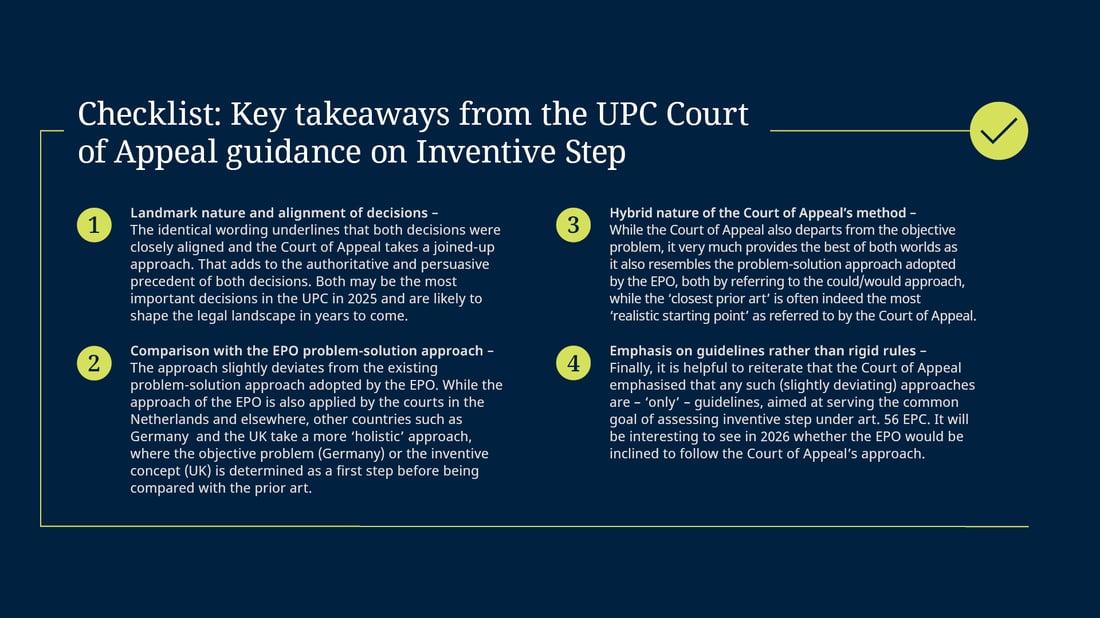
- The length of the legal principles outlined by the Court of Appeal underline that this clearly is a landmark decision. The principles outlined in UPC_CoA 528/2024 and 529/2024 also echo in UPC_CoA 464/2024, which was rendered on the same day, by the same Court of Appeal, but by different panels. The identical wording of said legal principles underlines that both decisions were closely aligned and the entire Court of Appeal takes a joined-up approach. That only adds to the authoritative and persuasive precedent of both decisions. Both may very well be the most important decisions in UPC in 2025 and are likely to shape the legal landscape in years to come.
- It is worth noting that the approach above slightly deviates from the existing problem-solution approach adopted by the EPO, which revolves around: (i) determining the “closest prior art” (ii) establishing the “objective technical problem” to be solved and (iii) considering whether or not the claimed invention, starting from the closest prior art and the objective technical problem, would have been obvious to the skilled person. While the approach of the EPO is also applied by the courts in e.g. The Netherlands and elsewhere, other countries such as Germany and the UK take a more ‘holistic’ approach, where the objective problem (in Germany) or the inventive concept (in the UK) is determined as a first step before being compared with the prior art.
- While the Court of Appeal also departs from the objective problem, it very much provides the best of both worlds as it also resembles the problem-solution approach adopted by the EPO, both by referring to the could/would approach (step 3), while the ‘closest prior art’ is often indeed the most ‘realistic starting point’ (step 2) as referred to by the Court of Appeal.
- Finally, it is helpful to reiterate that the Court of Appeal emphasised that any such (slightly deviating) approaches are – ‘only’ – guidelines, aimed at serving the common goal of assessing inventive step under art. 56 EPC. It will be interesting to see in 2026 whether the EPO would be inclined to follow the Court of Appeal’s approach.
Finally, both decisions also provide interesting guidance on claim interpretation, added matter and sufficiency. Such topics will be addressed in future editions of UPC Legal Compass.
Should you have any further questions or require assistance, please do not hesitate to contact us.